

Industrial UPS Price Guide: Cost Factors, Specifications and RFQ Checklist

“How much does a 20 kVA industrial UPS cost?” We get that question every week, usually by email, often with nothing else attached. It’s a fair question. It is also one we can’t answer honestly without asking six more, because two industrial UPS systems with the same kVA on the nameplate can differ in price by a factor of three or four.
That isn’t a sales trick. A commercial UPS is a catalogue product: fixed input, fixed output, a small internal battery, made in volume. An industrial UPS is closer to a piece of plant equipment. Its price follows from the load it protects, the site it sits in, the battery it carries and the documents that come with it. Change any of those and the bill of materials changes.
This guide explains where the money actually goes in an industrial UPS, which specification choices move the price the most, and what to put in an RFQ so that the first quotation you receive is close to the final one. The figures are indicative ranges from typical tailor-made projects in the 10 to 200 kVA band, not a price list. Use them to plan budgets and to read quotations critically.
Why “price per kVA” is the wrong starting point
In the commercial UPS world, price per kVA is a useful shortcut. Products are similar enough that comparing them on that basis makes sense. In industrial projects it falls apart quickly.
Take two 20 kVA units. The first is a three-phase in, three-phase out machine with 15 minutes of VRLA battery, sitting in an air-conditioned electrical room. The second takes 400 V three-phase in, delivers 110 V AC single-phase out, carries four hours of nickel-cadmium battery, is rated for 50 °C ambient, sits in an IP54 cabinet, and comes with a full set of drawings, calculation notes and a witnessed factory acceptance test. Both are “20 kVA industrial UPS”. The second one will cost several times the first, and every part of that difference is justified by engineering, not margin.
So the useful question isn’t “what does a 20 kVA cost?” but “what is this particular 20 kVA system made of?” Once you know that, the price becomes predictable.
Where the money goes: the cost structure of an industrial UPS

When we break down our own quotations, the cost falls into seven groups. The ranges are wide on purpose, because the share of each group shifts with the specification.
Power stage and magnetics (roughly 25–35%). This is the rectifier, the inverter, the static switch and, in a true industrial design, the input and output transformers. Transformers are heavy, copper-intensive and a big reason industrial units cost more than transformerless commercial ones. They also provide galvanic isolation, absorb disturbances and make the unit tolerant of faults downstream. We think they’re worth it in most plant environments, but they cost money.
Battery bank and rack (roughly 15–40%). No other line item moves as much. Ten minutes of VRLA battery for a 20 kVA unit is a modest cabinet. Four hours of NiCd is a battery room. Battery cost is also where buyers most often get surprised, because the autonomy figure in the specification was written years ago and nobody questioned it.
Engineering and documentation (roughly 8–15%). Drawings, calculations, project-specific firmware settings, document reviews with the client’s engineers, revisions. On projects governed by an oil company or utility specification, this share goes up, because the vendor document register can run to dozens of documents.
Enclosure and mechanics (roughly 8–12%). Cabinet, paint system, cable entries, gland plates, internal ventilation. A standard IP20 cabinet is cheap. An IP54 cabinet that still has to dissipate several kilowatts of heat is not, because the cooling has to be redesigned.
Control, monitoring and communication (roughly 5–10%). Display, alarms, dry contacts, Modbus, SNMP, IEC 61850 or Profinet interfaces. Rarely the big number, but specific protocol requirements can add development time.
Factory acceptance testing and certification (roughly 3–8%). A full-load FAT with a heat run, a battery discharge test and a client witness takes days of test bay time, load banks and engineers. Third-party or class certification adds more.
Packing and logistics (roughly 2–5%). Seaworthy packing for export, especially for heavy transformer-based units, is not trivial.
If you read a quotation and one group looks out of proportion, ask about it. Usually there’s a reason, and the conversation tends to reveal a specification point worth revisiting.
The seven factors that really decide the price
1. Battery autonomy and chemistry

We’ll start with the battery because it’s the biggest variable. Autonomy, meaning how long the UPS must carry the load without mains, scales battery capacity almost linearly, and price follows. Going from 10 minutes to 2 hours can nearly double the system price for the same kVA. Going to 4 hours on NiCd can take it close to four times.
Chemistry matters as much as minutes. VRLA lead-acid batteries are cheaper up front, compact and maintenance-light, but their life shortens sharply with temperature. A VRLA battery rated for 10 years at 20 °C may last half that in a 30 °C room. NiCd pocket-plate batteries cost more per kWh but tolerate heat, deep discharges and neglect far better, and often last 20 years or more. In hot climates or remote sites, NiCd frequently wins on lifetime cost even though it loses on the initial quote.
Two practical tips. First, check the autonomy requirement against reality: if the plant has a standby generator that starts in 15 seconds, does the UPS really need two hours? Sometimes it does (generator failure is a real scenario), but sometimes the figure was copied from an older project. Second, ask how the battery was sized. A proper sizing includes an ageing factor (usually 1.25), a temperature correction and a design margin. A quote that looks cheap may simply have skipped them.
2. Input and output configuration
Standard three-phase 400 V in and out is the easiest configuration. Departures from it cost money, not because they’re exotic but because they require specific transformers, different inverter designs and sometimes a different control board.
Common examples: 110 V AC single-phase outputs for control and instrumentation systems; 230 V AC output from a 690 V input; 60 Hz output from a 50 Hz grid; separate rectifier and bypass inputs from different switchboards; isolated outputs for floating (IT) distribution. None of these are unusual in industry, and a manufacturer who designs in-house will handle them without fuss. But they move the price.
3. Redundancy
A single UPS with a static bypass is the cheapest arrangement. A 1+1 parallel redundant system doubles the power hardware, adds paralleling controls and usually a common output switchboard. A dual-bus design with two fully independent UPS systems goes further. Redundancy is the second-biggest price driver after the battery.
The right answer depends on the consequence of failure. For a non-critical PLC panel, a single unit with bypass is fine. For a refinery’s emergency shutdown system, it isn’t. The data centre and power plant worlds have settled on different answers to this, and both are right for their context. The short version is this: decide redundancy on risk, then accept the cost, rather than the other way round.
4. Environment and enclosure

Ambient temperature, dust, humidity and altitude affect the design more than most buyers expect. A UPS designed for 40 °C will derate above that, typically by a few percent per degree. If the site is in the Gulf, North Africa or a non-air-conditioned substation, specify the real ambient and let the manufacturer size the power stage for it. Oversizing the semiconductors and fans to deliver full output at 50 °C costs money, but it costs less than a unit that trips every summer afternoon.
Enclosure rating follows the same logic. IP20 is for clean electrical rooms. IP31 or IP42 handles some dripping water and dust. IP54 and above require sealed cabinets with filtered or heat-exchanger cooling. Paint specifications for offshore or chemical environments add another layer. Our article on industrial UPS vs commercial UPS goes deeper into how these choices separate the two classes of product.
5. Standards and project specifications
Every industrial UPS should comply with IEC 62040 (safety, EMC and performance). Beyond that, project-specific requirements multiply. Oil and gas operators have their own UPS specifications that often override the IEC baseline. Utilities specify IEC 61850 communication. Marine projects require classification society approval. Defence projects bring MIL-STD environmental and EMC tests.
Each one adds engineering hours, documents and sometimes tests. A company specification can easily add 10–20% to the price of an otherwise standard system. That isn’t a reason to avoid it, but it is a reason to send it with the RFQ rather than after the order.
6. Documentation and testing
A commercial UPS ships with a user manual. An industrial project typically requires a general arrangement drawing, single-line diagram, wiring diagrams, battery sizing calculation, heat dissipation data, a FAT procedure and report, an operation and maintenance manual, a spare parts list and sometimes a reliability (MTBF) calculation. A witnessed FAT means your engineers or a third-party inspector watch the unit run at full load, transfer to bypass, discharge the battery and recover.
All of this is real work. It’s also what lets you sign off a system with confidence, so we’d never advise cutting it. Just budget for it.
7. Quantity, schedule and lifecycle support
One-off units carry the full engineering cost. Repeat orders of the same design spread it. Tight delivery schedules can mean premium freight or overtime. And lifecycle support, such as spare parts availability for 15 years, commissioning visits and service contracts, should be part of the comparison, even if it’s priced separately.
How a quote grows: an illustrative example
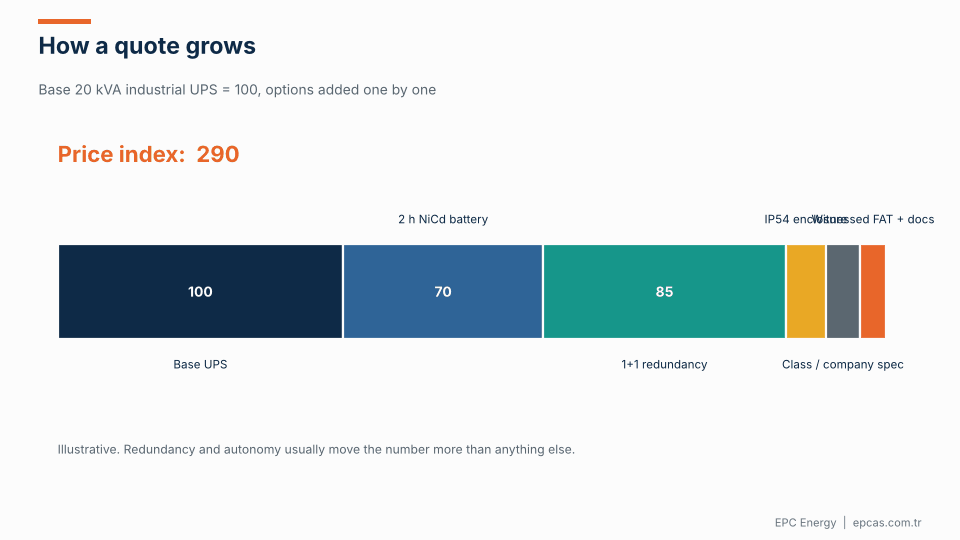
The animation above shows how a 20 kVA base unit (index 100) grows into a project price as options are added. Two hours of NiCd battery adds about 70 points. Going to 1+1 redundancy adds roughly another 85. An IP54 enclosure, compliance with a company specification and a witnessed FAT with full documentation add smaller amounts each. The total lands around 290, nearly three times the base unit.
Nothing in that example is exotic. It is a fairly normal industrial specification. The point is that the “price of a UPS” is mostly the price of the decisions around it.
Lifecycle cost: why the cheapest quote often isn’t
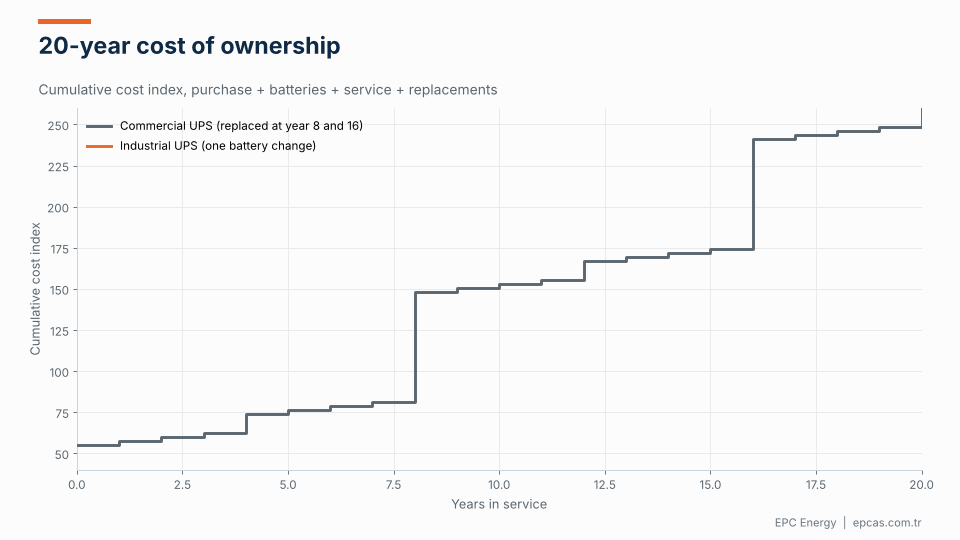
Purchase price is only the first entry in the ledger. A UPS in an industrial plant is expected to run for 15 to 25 years. Over that period you’ll pay for batteries, service visits, spare parts, energy losses and, if the unit wasn’t built for the job, replacement.
The animated chart compares two scenarios over 20 years. A commercial-grade UPS starts at roughly half the price of an industrial unit, but needs battery replacements every four years or so, and the whole unit is replaced at years 8 and 16 because it wasn’t designed for the environment or the duty. The industrial unit starts higher, gets one battery change and runs the full period. By year 8 the commercial option has already caught up; by year 20 it has cost far more.
These numbers are illustrative, and real outcomes depend on the site. But we see this pattern often enough that we’d encourage any buyer to ask for a lifecycle estimate alongside the purchase price.
How a UPS keeps the load running (and why it matters for price)
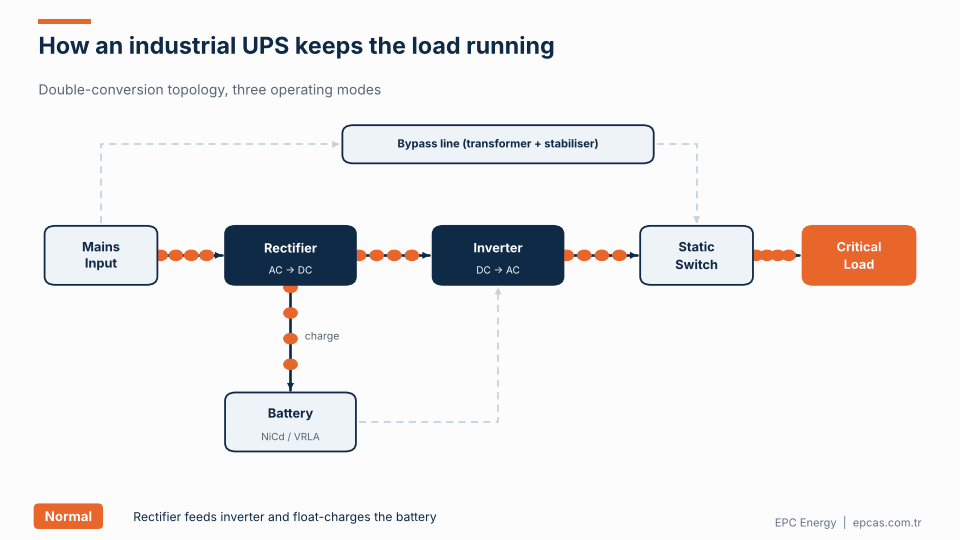
It helps to understand what you’re paying for. A double-conversion industrial UPS has three main operating modes:
- Normal mode. The rectifier converts incoming AC to DC, float-charges the battery and feeds the inverter. The inverter rebuilds a clean, stable AC output. The load never sees the mains directly.
- Battery mode. When the mains fails or goes out of tolerance, the rectifier stops and the battery feeds the inverter. There’s no transfer, so no break. This is why the battery and its sizing matter so much.
- Bypass mode. If the inverter is overloaded or faults, the static switch transfers the load to the bypass line, often through a bypass transformer and voltage stabiliser in industrial designs, so the load stays powered from the mains.
Each of these paths has components that have to be rated for continuous duty and for faults. In industrial units they’re oversized deliberately. That’s part of why they last.
Reading a quotation: questions worth asking
When you have quotes in hand, comparing the bottom line is tempting. Here are the questions we’d ask, as a buyer, before doing that:
- Is the battery sized to the same autonomy, at the same load, with the same ageing and temperature factors? If not, you aren’t comparing like with like.
- Is the unit rated for the site ambient, or will it derate? Ask for the derating curve.
- Are input and output transformers included? Some “industrial” units are commercial transformerless designs in a heavier cabinet.
- What exactly is included in the FAT? Full load? Heat run? Battery discharge? Witness?
- Who designed it? A manufacturer who owns the design can modify it and support it for decades. An assembler depends on someone else’s roadmap. We wrote about this in how to tell a UPS builder from an assembler.
- What’s the spare parts commitment? Ten years is the minimum we’d accept for plant equipment.
- Which deviations from the specification are listed? A quote without a deviations list either complies fully or hasn’t read the specification.
Industrial UPS RFQ checklist

The best way to control the price is to send a complete RFQ. The more we know at the start, the fewer surprises on both sides. Here’s what to include:
Load list. Every consumer the UPS will feed, with active power, power factor and inrush current. If you only have a total kVA, tell us how it was derived.
Input supply. Voltage, number of phases, frequency, earthing system, expected voltage and frequency tolerances. Whether there’s a separate bypass supply.
Output requirements. Voltage, phases, frequency, distribution board and breaker list, selectivity requirements.
Autonomy. Minutes, at what load, at end of battery life, and at what minimum temperature.
Battery chemistry. VRLA, vented lead-acid or NiCd, or “manufacturer to propose”. If there’s a preferred battery brand, say so.
Environment. Maximum and minimum ambient, altitude, dust, humidity, required IP rating, indoor or outdoor, any hazardous area classification.
Standards and specifications. IEC 62040 as a baseline, plus any company, utility, class or military specification. Include the revision number.
Testing and documents. FAT scope and witness requirements, required document list, language, approval process.
Commercial basics. Quantity, delivery date, Incoterms, warranty expectations, spare parts requirements.
If some of this isn’t decided yet, send what you have and say what’s open. A good manufacturer will help you close the gaps. Our engineers usually reply to complete specifications within two business days.
A note on “tailor-made” and why it doesn’t have to mean expensive
It’s easy to assume that a custom-engineered UPS costs more than a standard one by definition. Sometimes it does. But tailor-made also means not paying for things you don’t need: no oversized battery because the catalogue model only comes with one, no extra transformer stage because the output voltage isn’t standard, no third-party adaptations bolted onto a commercial product.
At EPC Energy, every industrial UPS is designed and built in our Istanbul facility, from specification review through full-load FAT. We’ve delivered more than 3,000 projects in over 55 countries since 1977, from 15 kVA 12-pulse UPS systems for Middle East telecom sites to multi-megawatt systems for transport infrastructure. Our tailor-made industrial UPS white paper explains the engineering approach in more depth.
Frequently asked questions
How much does an industrial UPS cost?
It depends on the specification more than the kVA. For the same rating, battery autonomy, redundancy, enclosure, ambient rating and documentation can change the price by a factor of three or more. The quickest way to an accurate figure is to send a complete RFQ with load list, autonomy, environment and applicable standards.
Why is an industrial UPS more expensive than a commercial UPS?
Industrial units use input and output transformers, are designed for 20–25 years of life, tolerate higher ambient temperatures and dirtier supplies, support external batteries with long autonomy, and come with full engineering documentation and factory testing. Commercial units are optimised for clean rooms and short lifecycles.
What has the biggest effect on industrial UPS price?
Battery autonomy and chemistry, followed by redundancy. Going from 10 minutes to several hours of autonomy, or from a single unit to a 1+1 redundant system, typically moves the price more than any other choice.
Is NiCd or VRLA cheaper for an industrial UPS?
VRLA is cheaper to buy. NiCd usually lasts two to three times longer, especially in hot environments, so over a 20-year life it is often cheaper overall. The right choice depends on ambient temperature, maintenance access and expected service life.
What should I include in an industrial UPS RFQ?
Load list with power factor and inrush, input and output voltages, autonomy at a defined load and end-of-life condition, battery chemistry, environmental conditions and IP rating, applicable standards and company specifications, FAT and documentation requirements, quantity and delivery date.
Get an accurate industrial UPS quote
Have a specification ready, or just a load list and a site? Send it to our engineering team at epcas@epcas.com.tr or through our contact page. We’ll review it, ask the questions that matter, and come back with a tailor-made proposal, not a catalogue price.