

Industrial UPS vs Commercial UPS: The Engineering Differences That Decide Whether It Survives
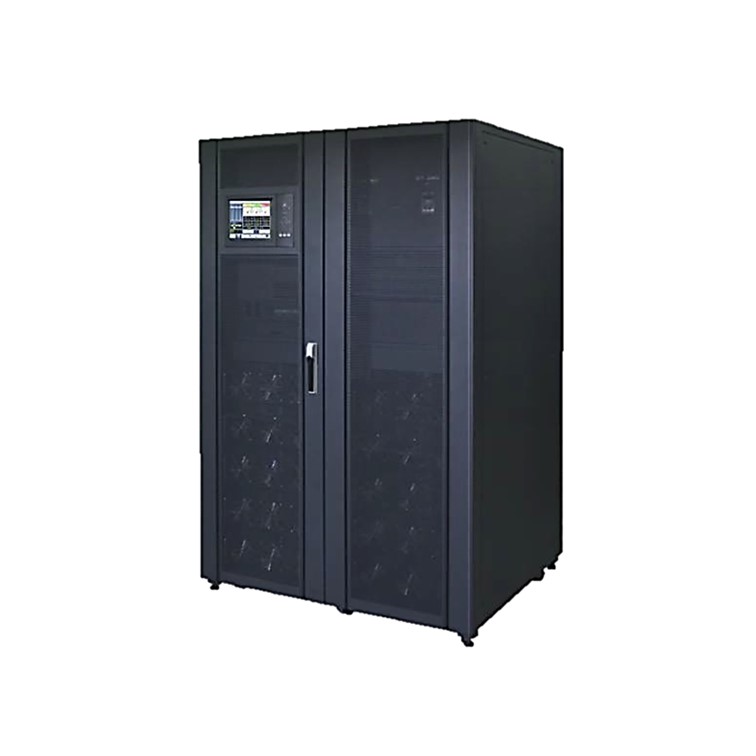
Both products convert AC to DC, store energy in a battery, and convert back to AC. Both are sold as uninterruptible power supplies. Beyond that, they share very little — and the gap between them is where a substantial number of process plants have learned an expensive lesson.
The problem is that the two look similar in a datasheet comparison. Same kVA. Same double-conversion topology. Same efficiency figure. One costs three times the other, and the procurement conversation almost always ends there.
What the datasheet does not show is that the two machines were designed against completely different assumptions about the world they will live in.
The assumptions behind a commercial UPS
A commercial or IT-class UPS is designed for a conditioned room. Ambient temperature 20–25 °C, controlled humidity, filtered air, minimal vibration. The loads are switch-mode power supplies with power factor correction — well-behaved, predictable, no meaningful inrush. Service life expectation is five to ten years, at which point the unit is replaced with a newer model. Volumes are high, margins are thin, and the design is optimised for cost, footprint and efficiency.
Every one of those assumptions is reasonable. None of them holds in a refinery, a substation, a pumping station, a paper mill or an offshore platform.
Overload and fault clearing: the decisive difference
This is the one that matters most, and it is the least discussed.
A typical IT UPS specifies something like 125 % for ten minutes and 150 % for thirty seconds. That is sized for a server room where the worst case is somebody plugging in more racks than the design allowed.
An industrial load bus behaves differently. A contactor coil pulls several times its holding current on pick-up. A solenoid valve does the same. A small direct-on-line motor draws six to eight times full-load current for seconds. And critically, when a fault occurs on a downstream circuit, something has to supply enough current to trip the protective device that clears it.
If your 100 A industrial UPS can only deliver 150 A before it current-limits, and the faulted circuit is protected by a 32 A type C MCB requiring roughly 320 A to trip magnetically, the breaker will not trip. The UPS goes into current limit, output voltage collapses, and the entire bus — every instrument, every controller, every safety-related load — goes down because of a short circuit on one branch circuit.
That is a total loss of selectivity, and it is precisely what an industrial UPS is designed to prevent. Industrial designs provide high short-duration current capability, often 300 % or more, or an automatic transfer to a bypass source that can supply the fault current, so that discrimination is preserved and the fault stays local.
Selective coordination is a design requirement, not a feature. It has to be calculated against the actual downstream protection, and it is one of the first things a serious specification should state.
Galvanic isolation and earthing
Commercial UPS designs are usually transformerless, which is what makes them light and efficient. In an industrial environment, that removes something you need.
Industrial installations frequently use IT earthing systems — unearthed or high-impedance-earthed — specifically so that a first earth fault does not stop the process, but instead raises an alarm. That scheme depends on the supply being genuinely separated from the upstream system. An input transformer, an output transformer, or both, provide that separation, create a separately derived neutral, and attenuate common-mode noise that would otherwise couple into instrumentation and analogue signals.
There is also the practical matter of voltage adaptation. Industrial sites run 690 V, 400 V, 480 V and 230 V systems in the same plant, sometimes on the same UPS bus. Transformers handle that; transformerless designs do not.
Industrial Frequency Conversion: Connecting 50 Hz, 60 Hz and 400 Hz Systems Efficiently
Batteries: chemistry, location, autonomy
An IT UPS assumes VRLA batteries in the cabinet, five minutes of autonomy, and a generator that starts.
Industrial autonomy requirements start at thirty minutes and run to eight hours, because there may be no generator, or because a controlled shutdown of a chemical process takes that long. That changes everything about the battery: it moves to a dedicated room or an external enclosure, it needs proper temperature management, and the chemistry choice becomes a real engineering decision.
Nickel-cadmium is common in industrial and substation applications for good reasons — tolerance of high and low ambient temperature, tolerance of deep discharge, service life of fifteen to twenty years, and predictable failure behaviour. It also has a very different charging profile and a wider cell-voltage range than lead-acid, which means the charger and the inverter input window have to be designed for it. A UPS built around VRLA assumptions cannot simply be pointed at a Ni-Cd bank.
Temperature is the other half of this. Lead-acid battery life roughly halves for every 10 °C above 20 °C. A battery rated for ten years at 20 °C manages about two and a half years at 40 °C. If the specification does not state the actual ambient the battery will experience, the autonomy calculation is fiction.
DC bus integration
Many industrial sites already have a 110 V or 220 V DC station battery serving protection relays, switchgear tripping and emergency lighting. It is maintained, monitored and proven.
The right answer is often not a second independent UPS with its own battery, but an inverter that draws from the existing station battery, plus a rectifier sized for the additional load. That halves the battery estate, halves the maintenance burden and removes an entire failure mode. It is also something a commercial UPS product simply cannot do — its DC bus voltage is an internal design parameter, not an interface.
Environment, enclosure and standards
Industrial units are built for the conditions: IP54 or higher, conformal-coated boards for humid or corrosive atmospheres, anti-vibration mounting, seismic qualification where required, forced ventilation with filtration or full sealing with heat exchangers.
Sector standards then layer on top:
- IEC 62040-3, which classifies UPS performance. VFI SS 111 — voltage and frequency independent, with the tightest transient and waveform classification — is what a critical industrial load should be specified against.
- IEC 60092 for marine and offshore installations.
- EN 50155 for rolling stock, with its shock, vibration and temperature-cycling requirements.
- ATEX / IECEx for hazardous areas.
- IEC 61850 where the unit must report into a substation automation system.
Each of these carries design consequences that cannot be retrofitted to a standard product.
Integration into the control system
A UPS in an office building reports to nobody. A UPS in a process plant is part of the asset management system, and its status is an input to operational decisions.
That means real protocol support — Modbus RTU over RS-485, Modbus TCP, Profibus, Profinet, IEC 61850 for substations, SNMP where the IT network is involved — with a documented register map rather than a proprietary gateway. It also means volt-free contacts for the hard-wired alarms that a safety system will not accept over a data link, and battery monitoring that reports actual cell condition rather than an estimated runtime derived from a lookup table.
Industrial Power Supply Solutions: Designing Power as a System, Not a Shopping List
Lifecycle, spares and obsolescence
A commercial UPS is a consumer of its own product cycle. Firmware moves on, boards are superseded, and after seven or eight years the manufacturer’s answer to a fault is a replacement unit.
An industrial plant designed for a thirty-year life cannot work that way. What matters is documented schematics, component-level repairability, guaranteed spare parts availability measured in decades, and the ability to service the equipment without a proprietary tool and a subscription. Over a twenty-year horizon, three replacements of a cheaper unit — plus three commissioning outages — comfortably exceed the cost of one machine built to last.
What a proper specification includes
If you take one thing from this: describe your installation, not the product you think you want.
State the load inventory with inrush characteristics and power factor. State the downstream protective devices, so selectivity can be calculated. State the ambient temperature at the UPS and separately at the battery. State the earthing system. State the required autonomy and the reason for it. State the communication protocol your DCS speaks. State the applicable sector standards. State whether an existing DC bus is available.
Then require a full-load Factory Acceptance Test before shipment, witnessed, including transfer tests, overload tests and a complete discharge at design load. A FAT is where specification meets reality, and it costs far less to discover a problem in the factory than on site.
Built to the specification, not to a catalogue
EPC Energy has designed and manufactured industrial UPS systems, rectifiers and inverters since 1977, with over 3,000 projects delivered in more than 55 countries. Our systems operate in power plants, refineries, telecom networks, marine platforms, rail infrastructure and data centres — each one engineered against the customer’s own specification, manufactured at our integrated facility in Istanbul, and subjected to full-load Factory Acceptance Testing before it ships.
If you have a technical specification or a load schedule, send it to our engineering team. You will get a proposed topology, a custom bill of materials and a design review — not a model number.