

Choosing an Industrial UPS Manufacturer: How to Tell a Builder from an Assembler

There are perhaps a few hundred companies worldwide describing themselves as industrial UPS manufacturers. A considerably smaller number actually design and build the equipment. The rest buy modules, populate a cabinet, add a logo and a warranty, and ship it. For an office building, that distinction barely matters. For a refinery, a substation, a metro line or a process plant with a twenty-five year design life, it decides whether you have a supplier or just a reseller with a service contract.
The difficulty is that you cannot tell the two apart from a website or a datasheet. Both show cabinets. Both quote efficiency figures. Both list the same standards. What follows is how to establish the difference before you place the order.
Ask who owns the design
The single most revealing question in a supplier meeting: “Who designed the inverter control board, and can your engineers modify it?”
A genuine manufacturer answers immediately — their own engineering team, and yes. An assembler either does not know, or explains that modifications require a request to their module supplier, which usually means the answer is no.
This matters because industrial projects almost always contain something non-standard. A DC bus voltage that must match an existing 110 V station battery. A specific communication protocol the plant DCS speaks. An output configuration with a neutral and 100 % unbalance capability. A cabinet that must fit an existing footprint. An earthing arrangement dictated by the site’s IT system.
If the supplier cannot change the design, every one of those requirements turns into either a compromise or an external add-on box bolted alongside the UPS — and the add-on box is where responsibility becomes ambiguous when something fails.
Look for magnetics
An easy and surprisingly reliable test: does the company design its own transformers and inductors, and does it wind them, or at minimum specify them to its own drawings?
Industrial UPS designs are typically transformer-based, precisely because galvanic isolation, separately derived neutrals and voltage adaptation are requirements rather than optional extras. The transformer is not a commodity in this context. Its impedance affects fault current and therefore selectivity. Its rating affects overload behaviour. Its construction affects noise, losses and temperature rise.
A supplier whose transformers arrive as a purchased part, selected from a catalogue by kVA rating alone, has already ceded control over the parameters that determine industrial performance.
Ask what they can test, at what power
This is where capability becomes physically verifiable.
A Factory Acceptance Test on a 300 kVA industrial UPS with 30 minutes of autonomy requires a load bank capable of absorbing 300 kVA continuously, at controllable power factor and controllable crest factor, plus the supply capacity to feed it, plus the ability to hold that load through a full battery discharge while the room removes the heat.
That is an infrastructure investment, and it is not something an assembler builds. When a supplier says they perform full-load FAT, ask what their maximum test capacity is, whether reactive and non-linear load banks are available, and whether you may witness the test in person. The answers separate the categories very quickly.
Specifically, a meaningful FAT should include: full-load run to thermal stability with temperature rise measurement, output voltage and frequency regulation across the input range, step load response, overload test to the specified multiple and duration, short-circuit or selectivity verification, transfer to and from bypass, complete battery discharge at design load, and verification of every alarm and communication point.
Everything on that list is cheap to discover in a factory and extremely expensive to discover on a live plant.
Check the standards claims properly
Every supplier lists standards. Fewer can produce the evidence.
IEC 62040-3 is the performance classification for UPS. The meaningful specification is VFI SS 111 — voltage and frequency independent, with the tightest classifications for output waveform under linear and non-linear load and for dynamic response to load steps. Ask for the classification statement and the test report, not a compliance sentence.
IEC 62040-1 covers safety. IEC 62040-2 covers EMC, and in an industrial environment the relevant category is C3 or C4, not the C1/C2 limits applicable to residential and light commercial equipment.
Then the sector standards, each of which carries real design consequences: IEC 60092 for marine and offshore, EN 50155 for rolling stock with its shock, vibration and temperature cycling requirements, ATEX/IECEx for hazardous areas, IEC 61850 where the unit reports into substation automation.
If the project falls under one of these, ask whether the supplier has previously delivered into that sector and can name the projects. Sector qualification is learned through delivery, not through reading the standard.
Ask about year fifteen
Industrial plants outlive product lifecycles. The question that matters is not what happens in the warranty period but what happens long after it.
Concretely: Will component-level schematics be provided? Are the power semiconductors and control components industry-standard parts available from multiple sources, or proprietary assemblies? What is the committed spare parts availability period? Can site technicians be trained to perform board-level diagnosis, or does every fault require a factory visit? Is there a documented obsolescence management plan for the control electronics?
A manufacturer that expects its equipment to run for twenty-five years has thought about all of this and can answer without hesitation. A company selling on a five-year replacement cycle usually cannot.
Over a twenty-year horizon, three replacements of a cheaper unit — including three commissioning outages and three requalification exercises — comfortably exceed the cost of one machine built to last, before anyone counts the production lost during each changeover.
Watch how they handle the awkward requirement
Every industrial project contains at least one requirement that does not fit neatly. A protocol nobody else asked for. An unbalanced single-phase load on a three-phase output. A room that will reach 48 °C in August. A battery already installed by someone else.
How a supplier responds to that requirement is the most reliable signal available.
A designer engages with it: asks follow-up questions, explains what it costs in efficiency or footprint, proposes two ways of solving it, and states plainly which parts are straightforward and which carry risk.
Industrial UPS vs Commercial UPS: The Engineering Differences That Decide Whether It Survives
An assembler does one of three things. Ignores it, and it disappears from the quotation. Declares it impossible, when it is merely outside their catalogue. Or agrees to everything without qualification, which is the most dangerous response of the three, because the problem then surfaces during commissioning when the equipment is already on site and the project has no schedule left.
Read quotations for what has been quietly dropped, not only for what has been included.
Verify the reference projects
Reference lists are easy to write. Useful verification is specific: ask for a project in your sector, at a comparable rating, delivered at least five years ago, and ask what has been serviced since.
The five-year condition is the important part. Anyone can deliver equipment. What tells you about a manufacturer is what the installation looks like after it has been through several summers, a few grid events, a battery replacement and at least one operator error.
What EPC Energy brings to this
EPC Energy has been designing and manufacturing power conversion equipment since 1977. Not assembling it — designing it, including the magnetics, the power electronics and the control systems, at an integrated facility in Istanbul with in-house R&D, manufacturing and test capability.
More than 3,000 projects delivered across over 55 countries, with roughly half of revenue coming from export markets. The installed base spans power generation, oil and gas, marine and offshore, rail and metro, telecommunications, defence, data centres and renewable energy — which is to say, the sectors where the standards above are contractual rather than aspirational.
The product range covers the full industrial power spectrum: Industrial UPS, Industrial Rectifiers, Industrial Inverters, Frequency Converters, Static Transfer Switches and Voltage Regulators, alongside EV charging and solar systems. That breadth matters more than it appears — when a site needs a UPS whose DC bus interfaces with an existing station battery, or a UPS supplied through a voltage regulator on a weak grid, a single supplier who designs both delivers one integrated system with one point of responsibility, rather than two boxes with an interface argument between them.
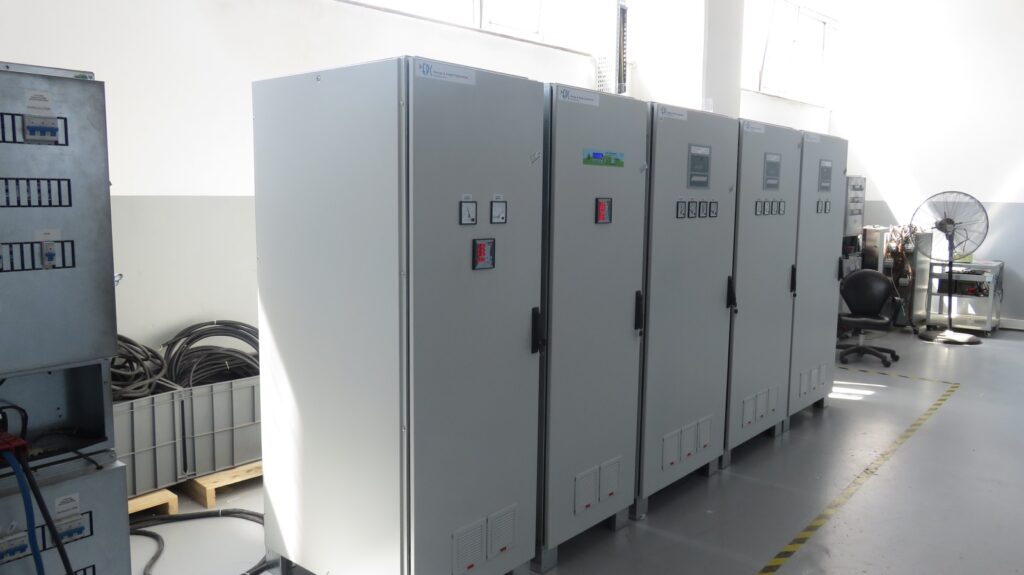
Representative delivered work includes a 48 V 360 kW DC power distribution and backup system for a data centre and telecommunications installation in the Netherlands, 145 VDC 700 A modular redundant rectifier systems for marine applications, 12-pulse thyristor rectifiers delivering 1200 A DC, and power plant auxiliary supply systems in North Africa.
Every system is engineered against the customer’s own specification, manufactured in-house, and subjected to full-load Factory Acceptance Testing — witnessed where the customer wishes — before it ships. Integration into plant control systems is supported over Modbus RTU and TCP, Profibus, Profinet and IEC 61850, with documented register maps rather than proprietary gateways.
How to start a real conversation
The fastest way to establish whether a supplier is capable is to send them something they have to think about rather than look up.
Send your load schedule with inrush characteristics and power factor. Send the downstream protective device ratings, so selectivity can be calculated rather than assumed. State the ambient temperature at the UPS and separately at the battery location. State the earthing system. State the required autonomy and why. State the communication protocol and the applicable sector standards.
A manufacturer will come back with a proposed topology, a rating derived from your numbers, and questions about the things you left out. An assembler will come back with a model number.
Send your specification to EPC Energy’s engineering team and see which response you get.