

What Separates a Real Industrial Rectifier Manufacturer: Capability Is Proven at the Extremes

Any competent electronics company can build a 20 A rectifier. The population of companies that can build a 1200 A DC system, prove it at full load before shipment, and still be supporting it in twenty years is much smaller.
That is the useful thing about rectifiers as a category: capability scales visibly. Current, thermal management, magnetics, busbar engineering, fault behaviour — all of them become progressively harder as the rating rises, and none of them can be faked in a datasheet. If you want to evaluate an industrial rectifier manufacturer, look at the hardest thing they build and how they prove it works.
Why rectifier projects go wrong
Almost never because the rectification does not work. The failures cluster in five places.
Thermal. Loss concentrates in a small number of devices, and semiconductor ratings derate steeply with junction temperature. A stack designed for a 40 °C ambient installed in a 50 °C plant room is running on borrowed margin.
Harmonics. A six-pulse bridge produces input current THD around 25–30 %, with dominant fifth and seventh orders. Transformers overheat, neutral conductors carry more than expected, and the utility connection agreement may simply prohibit it.
Power factor. In a phase-controlled thyristor bridge, displacement power factor degrades as firing angle advances. At reduced output the supply, cabling and transformer must be sized for far more apparent power than the DC load consumes.
Fault behaviour. If a downstream fault cannot draw enough current to trip its protective device, the rectifier current-limits and the whole DC bus collapses over a fault on one branch circuit.
Voltage window mismatch. Particularly in battery applications. A nickel-cadmium string on a nominally 110 V system swings from roughly 92 V at end of discharge to over 150 V during boost charge. Every connected load has to tolerate that, or the design needs a dropper or DC/DC stage. This gets discovered at commissioning with depressing regularity.
A manufacturer worth buying from raises all five of these before you do.
Choosing an Industrial UPS Manufacturer: How to Tell a Builder from an Assembler
The questions that reveal capability
“What is the highest DC current you have delivered, and can I see the test report?”
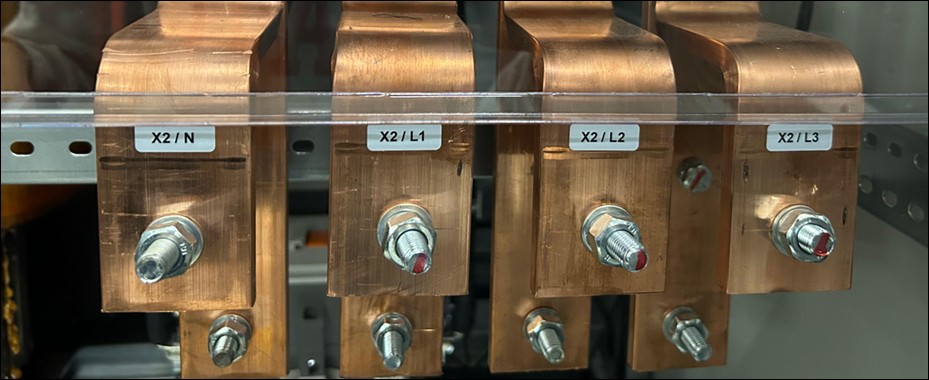
High-current DC is where engineering shows. It is not simply more devices in parallel — it is current sharing between stacks, busbar design where a few hundred microhms matters, connection torque and thermal cycling, magnetic field effects on adjacent equipment, and cooling systems that are genuinely engineered rather than specified by fan count.
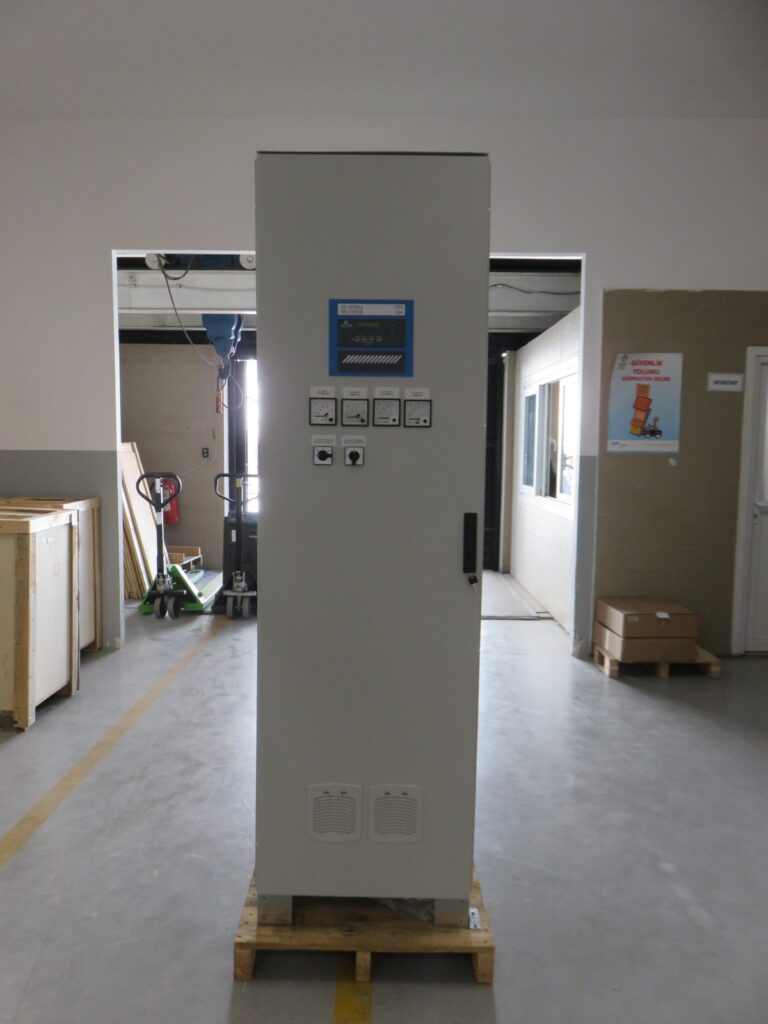
“Do you design your own transformers?”
For a twelve-pulse rectifier, the phase-shifting transformer with delta and star secondaries 30° apart is what cancels the fifth and seventh harmonics. Its impedance, balance and construction directly determine whether the harmonic performance in the test report matches the harmonic performance on site. A supplier who buys transformers on kVA rating alone has outsourced the parameter that defines the product.
“What can you test, and at what power?”
Verifying a 1200 A rectifier requires a load bank that absorbs 1200 A continuously, held long enough to reach thermal equilibrium, with measurement of ripple, regulation, temperature rise and input harmonic spectrum. That is heavy infrastructure. It is also the only way to know before shipment.
A proper Factory Acceptance Test should include: full-load run to thermal stability with temperature rise recorded at defined points, output voltage regulation across the full input voltage range, ripple voltage and ripple current at full load with the battery disconnected — the meaningful condition, since a large battery across the output makes almost any rectifier look clean — current limit verification, float and boost transition behaviour, input harmonic measurement, redundancy and module failure simulation where applicable, and verification of every alarm and communication point.
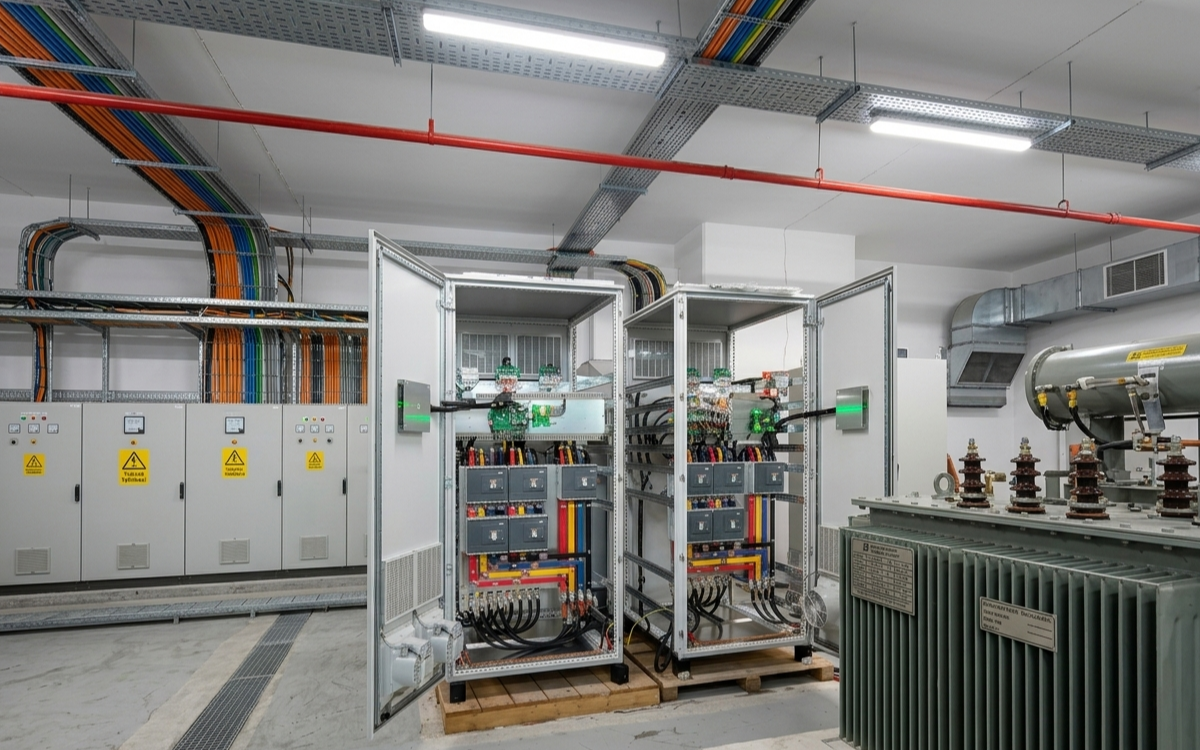
“Which topology would you propose for this, and why?”
The answer separates engineers from salespeople. There is no universally superior topology.
Thyristor rectification wins where DC current is very high, where the supply is weak or distorted, where fault withstand and overload capability are critical, and where a thirty-year service life demands commodity, multi-source components repairable with a multimeter.
IGBT-based rectification wins where harmonic limits are strict — sub-5 % THD and near-unity power factor by construction — where dynamic response must be fast, where size and weight are constrained, or where modular hot-swappable redundancy is required, as in telecom DC plants.
A supplier who proposes the same topology for every enquiry is selling what they have rather than what you need.
What Are Industrial Rectifier Systems? Applications, Benefits & Types
Application-specific requirements that catalogue products miss
Substation battery chargers need the float, boost and equalise regimes appropriate to the chosen chemistry, temperature-compensated charging with the sensor on the battery rather than in the cabinet, ripple below the battery manufacturer’s limit, insulation monitoring for the unearthed DC bus with fault polarity indication, battery open-circuit detection, and dual-charger load sharing where redundancy is required.
Telecom DC plants need modular hot-swappable rectifiers with N+1 sizing, two-stage low voltage disconnect, automatic battery testing, SNMP for the network management system, and outdoor enclosures qualified against the actual environmental class.
Marine and offshore rectifiers need IEC 60092 compliance, conformal-coated boards, shock and vibration qualification, salt-mist resistance and often modular redundancy because a repair at sea is not a same-day event.
Process and electrochemical applications — plating, anodising, electrolysis — need very high current at low voltage, tight current regulation, reverse-pulse capability in some processes, and ripple performance that directly affects product quality rather than merely equipment life.
Each of those is a different machine. A manufacturer with genuine engineering capability treats them as different machines.
Cooling is where reliability is actually decided
Rectifier failures are overwhelmingly thermal in origin, and cooling is the part of the design most often treated as an afterthought.
Forced-air cooling is simple and adequate to surprisingly high ratings, but fans are wear items. Ask what their rated life is, whether they are redundant, whether failure is alarmed before it causes a trip, and whether they can be replaced without taking the unit out of service.
Filtered air introduces a maintenance obligation. In dusty environments — cement, mining, quarrying, desert installations — a blocked filter produces exactly the same result as a failed fan, on a slower timescale and with no alarm unless one has been specified. Sealed enclosures with air-to-air heat exchangers cost more and remove the problem.
Water cooling becomes worth considering at very high currents, bringing its own requirements: coolant quality, flow monitoring, leak detection and freeze protection.
Whatever the method, the specification should state the actual site ambient and altitude rather than a comfortable assumption. Semiconductor ratings derate steeply with junction temperature, and a stack qualified at 40 °C installed in a 50 °C plant room has consumed its design margin before it is switched on.
Longevity, spares and repairability
Rectifiers installed in substations and process plants are expected to outlast several generations of consumer electronics.
Ask what the spare parts commitment period is. Ask whether the power semiconductors are industry-standard devices available from multiple manufacturers or proprietary assemblies. Ask whether component-level schematics are supplied. Ask whether site technicians can be trained to diagnose to board level.
Ask specifically about capacitors. Electrolytic capacitors in DC links and auxiliary supplies are the dominant wear-out mechanism in most power electronics, and their life is strongly temperature-dependent. Cooling design and capacitor selection contribute more to twenty-year reliability than the choice of switching device does.
EPC Energy’s rectifier capability
EPC Energy has been designing and manufacturing industrial rectifiers since 1977, with in-house engineering, magnetics, manufacturing and test capability at an integrated facility in Istanbul. More than 3,000 projects delivered across over 55 countries, with about half of turnover in export markets.
Delivered rectifier work includes 12-pulse thyristor systems producing 1200 A at 28 VDC, 145 VDC 700 A modular redundant rectifier systems for marine applications, and a 48 V 360 kW DC power distribution and backup system for a data centre and telecommunications installation in the Netherlands. The installed base covers power generation, oil and gas, marine and offshore, rail and metro, telecommunications, defence, data centres and renewable energy.
Because EPC also designs Industrial UPS, Industrial Inverters, Frequency Converters, Static Transfer Switches and Voltage Regulators, DC systems can be delivered as a complete power architecture rather than a collection of separately procured boxes — a rectifier feeding an inverter from a shared station battery, or a rectifier fed through a voltage regulator on a weak grid, engineered as one system with one point of responsibility.
Every unit is built to the customer’s specification, integrated with plant control systems over Modbus RTU and TCP, Profibus, Profinet or IEC 61850 with documented register maps, and full-load tested before shipment. Customers are welcome to witness the Factory Acceptance Test.
One question worth asking last
Ask the supplier what they would do differently if the budget were 15 % higher, and what they would remove if it were 15 % lower.
A manufacturer answers with engineering: a twelve-pulse configuration instead of six with a filter, a larger heatsink and lower junction temperature for longer capacitor life, N+1 instead of N, a sealed enclosure instead of filtered ventilation. Every item traceable to a consequence.
An assembler answers with a different model number, or with nothing at all.
Starting the enquiry properly
Send the DC load schedule with continuous and momentary components separated. State the battery chemistry, cell count and required recharge time if there is one. State the harmonic limits at the point of connection. State the ambient temperature and altitude at the installed location, not the design ambient you would prefer. State the earthing arrangement, the required redundancy and the communication protocol.
Our engineering team will return a topology recommendation with the reasoning behind it, a bill of materials and a sizing calculation you can check — not a catalogue page.