

Tailor Made Power Solutions: What Custom Engineering Actually Means, Step by Step
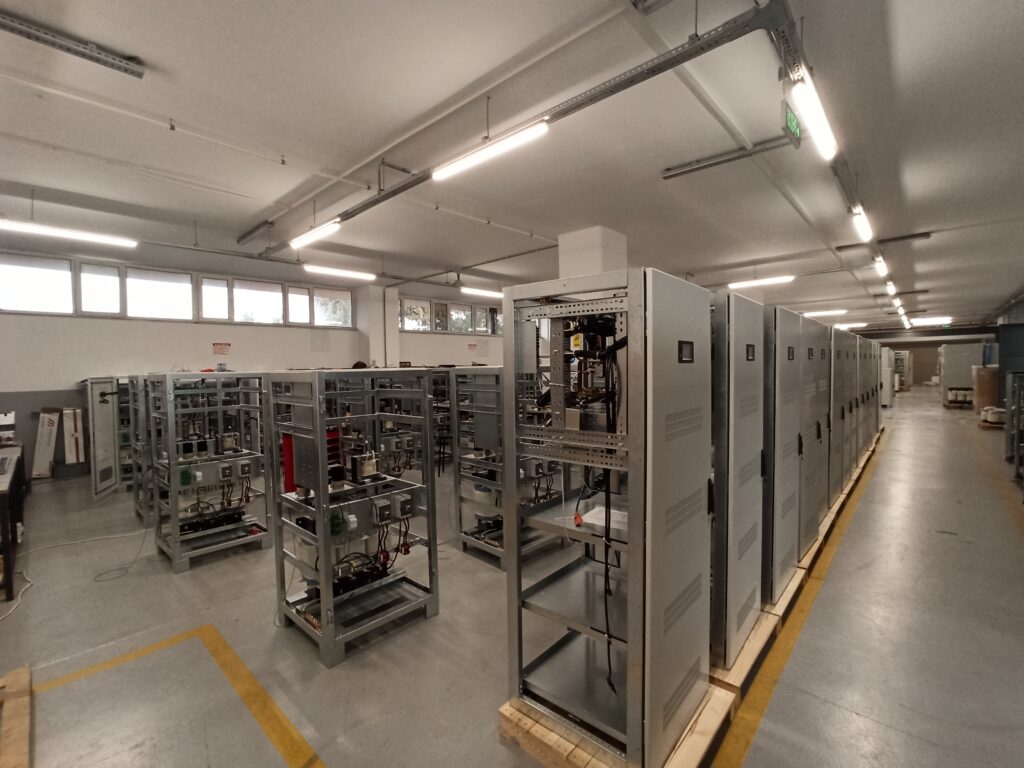
“Custom” is a word that survives contact with almost any marketing department. In power electronics it can mean anything from a genuinely bespoke design to a standard product with a different paint colour and an extra terminal block.
The distinction is worth pinning down, because the projects where it matters are exactly the projects where getting it wrong is expensive. Here is what tailor made power engineering involves in practice, when it is justified, and how to tell whether a supplier is actually doing it.
When standard products stop fitting
Off-the-shelf equipment exists because most applications resemble each other. The moment one parameter falls outside the assumed envelope, the economics change.
Non-standard voltages. Site DC systems run at 24, 28, 48, 60, 110, 145 or 220 V, and an existing station battery cannot be renegotiated to suit a supplier’s product line. Equally, AC systems mix 230, 400, 460 and 690 V, sometimes on the same bus.
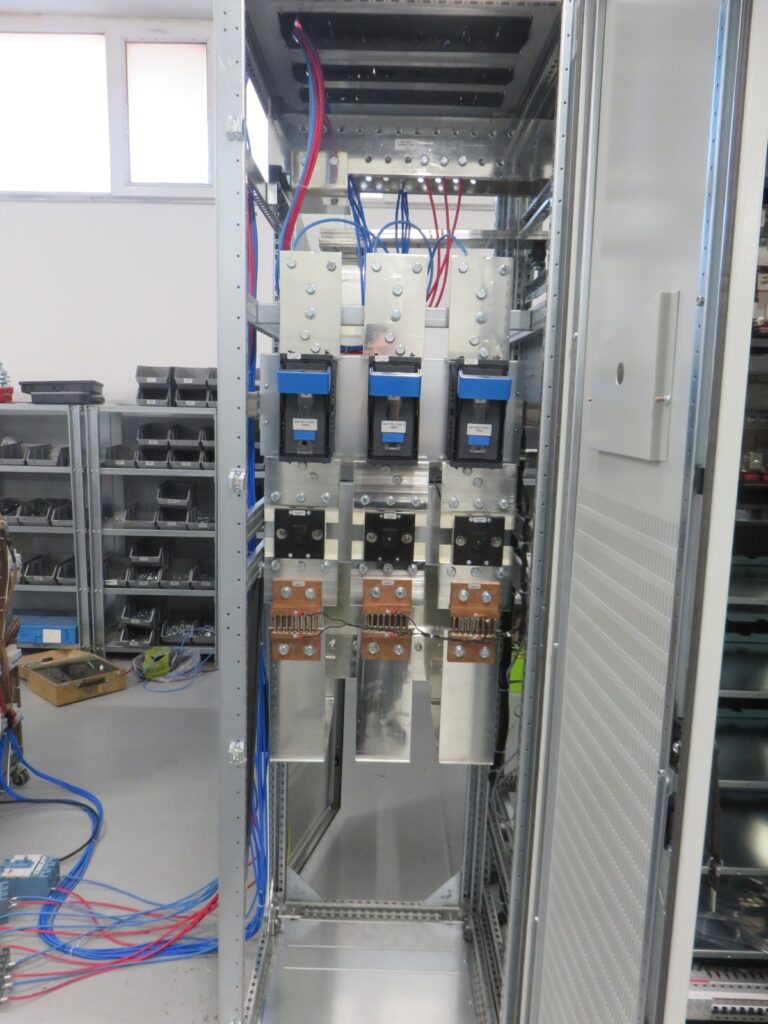
Selectivity requirements. If a downstream fault must trip its own protective device without collapsing the bus, the source has to supply substantial fault current for a defined period. Standard products current-limit at a fraction of what a 32 A type C MCB needs to trip magnetically, and the entire bus goes down over a fault on one circuit.
Choosing an Industrial UPS Manufacturer: How to Tell a Builder from an Assembler
Environment. Ambient temperatures of 50 °C, altitude derating, salt mist, dust, vibration, corrosive atmospheres, hazardous area classification, seismic qualification. Each one changes the enclosure, the cooling, the component selection and the derating calculation.
Sector standards. IEC 60092 for marine, EN 50155 for rolling stock, ATEX or IECEx for hazardous areas, IEC 61850 for substation automation, defence specifications with their own qualification regimes. These are not labels applied at the end; they shape the design from the beginning.
Integration with what already exists. An inverter that must draw from the plant’s existing 110 V station battery. A rectifier that must share a DC bus with installed equipment. A UPS whose alarms must appear in a DCS that speaks one specific protocol. A cabinet that must fit the footprint of the unit being replaced, in a room whose door was bricked up in 1994.
Load behaviour. Loads with high inrush, poor power factor, high crest factor, or heavy phase unbalance from single-phase auxiliaries on a three-phase system. Standard products commonly tolerate 30 % unbalance; a machine with substantial single-phase loading needs 100 %.
Any one of these can be worked around. Three or four together, and the workarounds cost more than the engineering would have.
The process, honestly described
A tailor made project that works follows a recognisable sequence. If a supplier cannot describe theirs, that is informative.
- Requirement capture. Not a product enquiry — a technical conversation. What is the load, in detail? What starts when, and how? What is the earthing system? What protective devices are downstream? What is the ambient at the equipment and separately at the battery? What autonomy, and why that figure? Which standards apply? What has to be talked to, over which protocol? What are the physical constraints?
The quality of this stage determines everything downstream. A supplier who skips it and quotes from a kVA figure has made assumptions you will discover during commissioning.
- Concept and topology. The engineering decisions: transformer-based or transformerless, thyristor or IGBT, six-pulse or twelve-pulse, modular or monolithic, single unit or N+1 redundancy, integrated bypass arrangement. Each choice carries consequences for harmonics, fault behaviour, footprint, efficiency and serviceability, and each should be explained rather than asserted.
- Detailed design. Magnetics designed and specified. Semiconductors selected and derated against the actual ambient and altitude. Busbars sized. Thermal model built. Control and protection logic defined. Communication mapping documented. Enclosure engineered to the environmental classification and the physical constraint.
- Design review with the customer. Single-line diagram, general arrangement, calculation set. This is where a discrepancy costs an email rather than a site visit — and where the customer’s own engineers can check the assumptions made about their plant.
- Manufacture. In-house, or at least under the designer’s direct control, which is the only arrangement in which a design change during build is a decision rather than a negotiation.
- Factory Acceptance Test. Full load, to thermal stability, with the customer present if they wish. Regulation across the input range, waveform distortion under linear and non-linear load, step-load response, overload to specification, unbalanced-load test where a neutral is provided, complete battery discharge at design load where applicable, and verification of every alarm and communication point.
A FAT is not a formality. It is where the specification meets physics, and it is a great deal cheaper to discover a problem in a factory than on a live plant.
- Site commissioning, documentation and support. Schematics at component level, a spare parts list with committed availability, training where the site will self-maintain, and a support arrangement that survives the warranty period.
How to tell whether a supplier really does this
Ask who owns the design. “Can your engineers modify the inverter control board?” A designer answers immediately and affirmatively. An assembler explains a request process to a module supplier.
Ask about magnetics. Transformers and inductors are not commodities in industrial power. Their impedance affects fault current and therefore selectivity; their construction affects overload capability, losses and temperature rise. A supplier selecting them from a catalogue on kVA alone has ceded the parameter that defines industrial performance.
Ask what they can test, at what power. Full-load testing a 500 kVA system requires a load bank absorbing 500 kVA at controllable power factor and crest factor, plus the supply capacity and the heat rejection to sustain it. That is infrastructure, and it is not something an assembler builds.
Ask for a comparable reference, five years old. Anyone can deliver equipment. What tells you about a manufacturer is what an installation looks like after several summers, a few grid events, a battery replacement and at least one operator error.
Ask about year fifteen. Spare parts commitment period, multi-source semiconductors, component-level schematics, and whether site technicians can be trained to board-level diagnosis.
What tailor made does not mean
Two clarifications save a lot of wasted discussion.
It does not mean everything is designed from nothing. Serious manufacturers work from proven platforms — validated topologies, qualified component sets, established control architectures — and configure and extend them to the requirement. That is a strength, not a compromise: a design built entirely from scratch carries risk that a platform-based design has already retired through field experience. What matters is that the platform can genuinely be modified, not that it is redrawn each time.
It also does not mean an indefinite lead time. Engineered equipment takes longer than pulling a box from stock, but a competent manufacturer quotes a realistic schedule at the outset and holds it. A supplier who promises a bespoke system on a catalogue lead time is either not doing the engineering or not planning to hit the date.
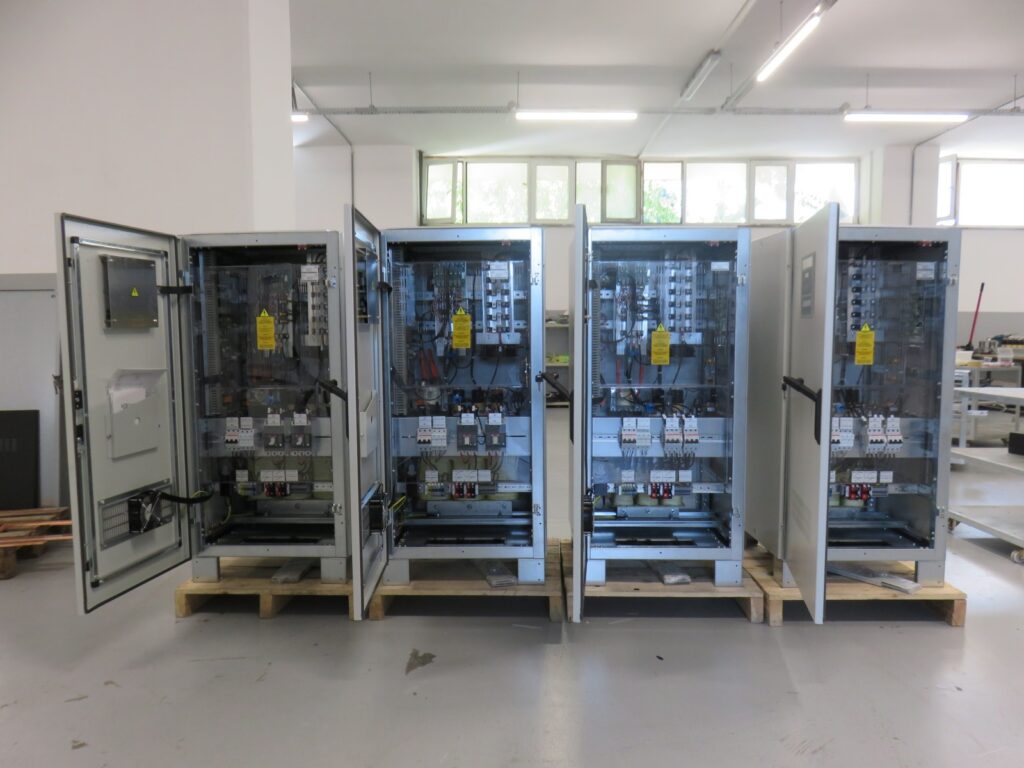
The cost question, addressed directly
Tailor made equipment costs more than a catalogue product. That is real and should not be pretended away.
What it buys is the removal of the workarounds: no external transformer to adapt a voltage, no additional cabinet to provide isolation, no compromise on autonomy because the standard battery configuration did not suit, no loss of selectivity, no annual argument about which supplier owns a failure at an interface.
And over a twenty-five year plant life, the arithmetic tends to favour the engineered solution. Three replacements of a shorter-lived unit — with three commissioning outages, three requalification exercises and three periods of production disruption — comfortably exceed one machine designed to last, before anyone counts the cost of the outage that prompted the first replacement.
Documentation is part of the deliverable
On engineered equipment the documentation set is not paperwork attached to the product — it is half of what makes the product maintainable.
A complete set includes component-level schematics rather than block diagrams, the general arrangement with cable entry and access clearances, the calculation set behind the sizing, the derating basis for the site conditions, the communication register map, the FAT report with measured values rather than pass marks, a commissioning procedure, a maintenance schedule, and a spare parts list with part numbers and committed availability.
Ask to see a sample documentation package from a previous project before ordering. It takes ten minutes to review and tells you more about a supplier’s engineering culture than a factory tour does.
EPC Energy: engineered to specification since 1977
EPC Energy designs and manufactures industrial power conversion equipment at an integrated facility in Istanbul, with in-house R&D, magnetics, production and full-load test capability. More than 3,000 projects delivered across over 55 countries, with roughly half of turnover in export markets, serving power generation, oil and gas, marine and offshore, rail and metro, telecommunications, defence, data centres and renewable energy.
Middle East Telecom Project – 15kVA 12-Pulse Industrial UPS System
The range spans Industrial UPS, Industrial Rectifiers, Industrial Inverters, Frequency Converters, Static Transfer Switches and Voltage Regulators, alongside EV charging and solar systems — designed as a single engineering capability rather than separate product lines, which is what allows a complete power architecture to be delivered as one system with one point of responsibility.
Delivered examples include 12-pulse thyristor rectifiers producing 1200 A at 28 VDC, 145 VDC 700 A modular redundant marine rectifier systems, a 48 V 360 kW DC power distribution and backup system for a data centre and telecommunications installation in the Netherlands, and power plant auxiliary supply systems in North Africa.
Send us the problem, not the product code
The most useful enquiry describes the installation rather than the equipment: load schedule with inrush and power factor, downstream protection ratings, earthing system, ambient conditions at equipment and battery, required autonomy and its justification, applicable standards, communication protocol, physical constraints.
Our engineering team will return a proposed topology, a sizing calculation you can check, and a bill of materials — plus questions about whatever the schedule left out. That exchange is where a tailor made solution actually begins.