

Critical Power Systems: Reliable UPS, Battery, and Backup Power Solutions

There is a category of electrical load whose defining property is that failure is not priced in money. The protection relay that must trip the moment a transformer faults. The tunnel ventilation controller during a fire. The operating theatre in minute forty of a procedure. The navigation bridge of a vessel in a shipping lane. The data hall carrying transactions that cannot be replayed. For these loads, the annual electricity bill is a rounding error and the five minutes a year when the grid misbehaves are the entire design problem.
Critical power systems are the engineering discipline built around those five minutes. The field has its own grammar — autonomy, redundancy, selectivity, single points of failure — and its own culture, in which every claim is tested, witnessed, and documented before anyone relies on it. It is the culture EPC Enerji has worked in since its founding, manufacturing the rectifiers, UPS systems, inverters, and transfer equipment that critical installations stand on, and delivering them into the sectors where the discipline is not optional: power generation, oil and gas, defense, marine, transportation, healthcare-grade infrastructure, and data facilities.

What Makes a Load “Critical” — and Why the Definition Matters
Plants habitually over-assign criticality, and the habit is expensive. The useful test is consequence, applied coldly: if this load loses power for one second, for one minute, for one hour — what actually happens? The answers sort loads into tiers, and the tiers drive the architecture.
Some loads tolerate nothing: protection and control systems, safety instrumented systems, flight-critical and navigation equipment, life-supporting medical loads. These get continuous conversion — UPS or DC systems where the load never touches raw mains at all — with battery autonomy behind them.
Some loads tolerate seconds: they ride through on stored energy while a generator starts, or transfer between sources through automatic and static transfer switches. Much of a facility’s essential-but-not-instantaneous load lives here.
Some loads merely need orderly shutdown: enough autonomy to close valves, park machinery, and save state. And everything else — the majority of any facility — is simply interruptible, however loudly its owners object during the workshop.
Getting this classification honest is the highest-leverage hour in any critical power project, because every tier of protection costs real money in equipment, batteries, losses, and maintenance forever after. EPC Enerji’s application engineers push for this analysis at the proposal stage precisely because it shrinks and sharpens the system that eventually gets built.
The Building Blocks and How They Combine
Critical power architectures are assembled from a small set of machines whose combinations produce very different availability outcomes.
The DC system — rectifier-charger plus battery — is the deepest layer, the one that must survive everything else failing. It holds protection relays, breaker trip circuits, control systems, and communications alive with autonomy measured in hours, engineered around battery chemistry, temperature, and certified discharge tables. Utilities and process plants treat it as the last system standing, and specify accordingly.
The industrial UPS manufactures continuous clean AC through double conversion, with a static bypass standing behind the inverter and a maintenance bypass behind everything. Its industrial character — overload capacity, fault-clearing current, isolation, environmental tolerance — was covered in depth elsewhere on this site; in the critical power context, what matters is its role as the AC continuity engine.
Inverters off the station battery give essential AC loads a path fed from the deepest energy reserve in the plant. Static transfer switches move loads between independent sources in milliseconds, enabling dual-bus architectures. Automatic transfer switches marshal the generator handover. Voltage regulators keep chronic supply deviation from eroding everything upstream of the critical bus.
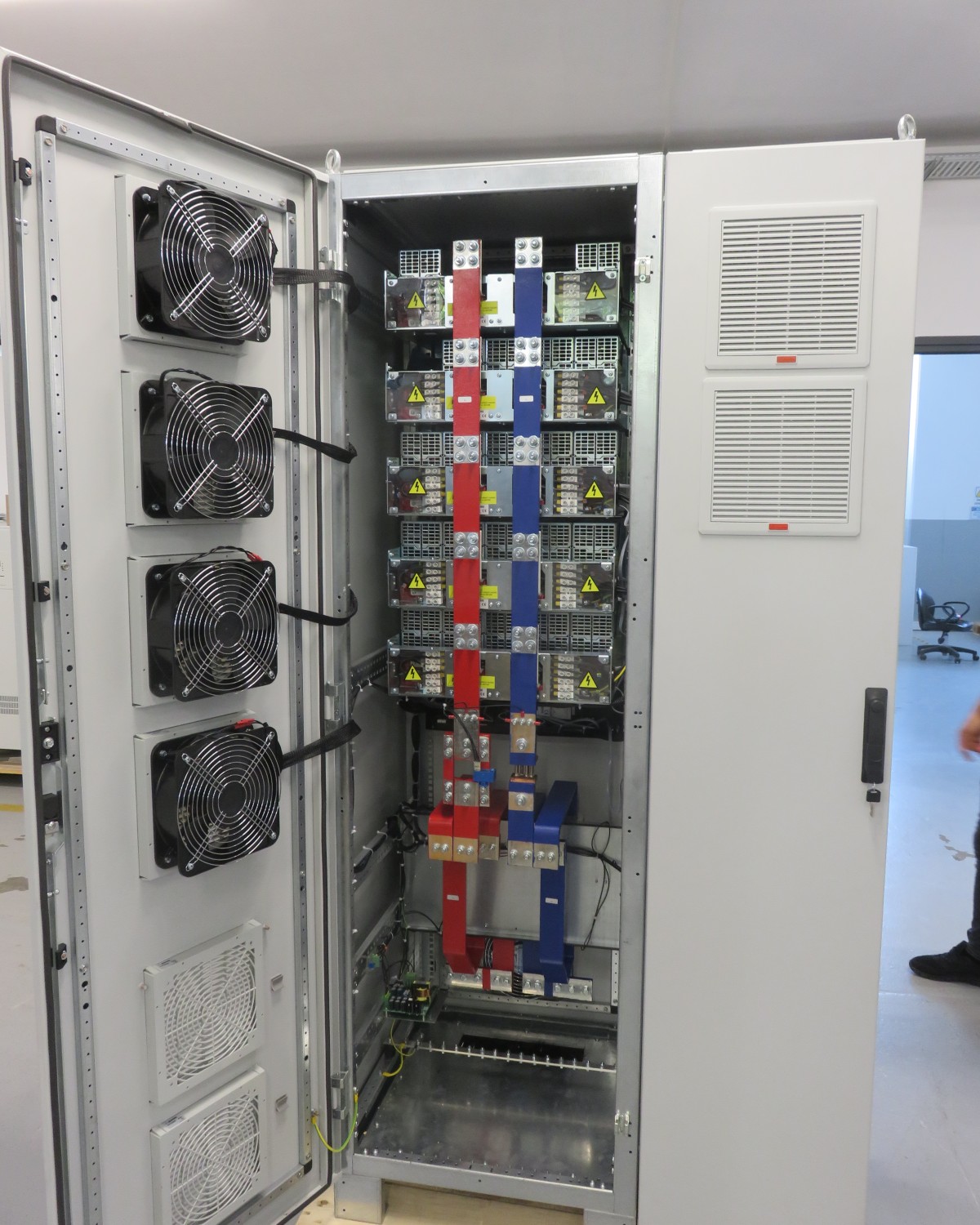
Redundancy is then a matter of arrangement: N+1 parallel systems that survive any single unit’s failure; 2N dual-bus architectures that survive the failure of an entire path; distributed schemes that place smaller systems close to loads. Each step up buys availability and costs capital, losses, and complexity — and the correct stopping point is a property of the consequence analysis, not of the vendor’s enthusiasm. Because EPC Enerji manufactures every block in this list, its proposals can move freely across these architectures and price them against each other honestly.
The Discipline: Testing, Documentation, Witnessed Proof
What separates critical power culture from ordinary equipment supply is the burden of proof. In this field, a datasheet is a claim; a type test is evidence; a witnessed factory acceptance test is the standard.
A serious critical power project generates a paper trail with teeth: battery sizing calculations against certified discharge data at the design temperature; fault studies proving that downstream breakers trip selectively on converter-limited fault current; heat load and loss budgets for the equipment rooms; alarm schedules mapped to the plant SCADA; FAT protocols executed at the factory with the customer’s inspectors watching the overload tests, the transfer times, and the battery discharge with their own instruments.
This is the working rhythm at EPC Enerji’s Istanbul facility. The company’s history in defense programmes, marine classification work, and utility projects — environments where inspectors read everything and forgive nothing — has made witnessed testing and full documentation the house standard rather than a premium option. Customers in less regulated sectors inherit that standard by default, which is one of the quieter advantages of buying critical equipment from a manufacturer formed by demanding ones.
Sector Notes from the Field
Substations and power plants remain the purest expression of the discipline: the power system protecting the power system. DC autonomy requirements, dual-branch chargers, inverter-fed essential AC, and grid-code compliance define the scope, and the equipment is expected to outlive the careers of everyone at the commissioning.
Oil, gas, and petrochemical installations bind criticality to safety: emergency shutdown systems, fire and gas panels, and instrumentation whose power integrity is part of the plant’s safety case. Environmental margin — heat, corrosion, dust — is specified, inspected, and then relied upon for decades.
Industrial Power Supply Solutions: Designing Power as a System, Not a Shopping List
Transportation infrastructure distributes the problem geographically: signalling rooms, tunnel safety systems, and station services spread across a network, each needing autonomous protection and remote monitoring. EPC’s transportation portfolio has grown alongside the region’s rail and metro investment for exactly this reason.
Marine and defense compress it: an entire critical architecture inside a hull or a hardened facility, built to classification or military standards, tolerant of vibration, shock, and salt, and documented to the satisfaction of professionally suspicious authorities.
Data centres industrialise it: availability expressed in nines, redundancy expressed in topology, and efficiency at partial load audited as closely as capacity — because a redundant system spends its life at half load, and the electricity bill knows it.
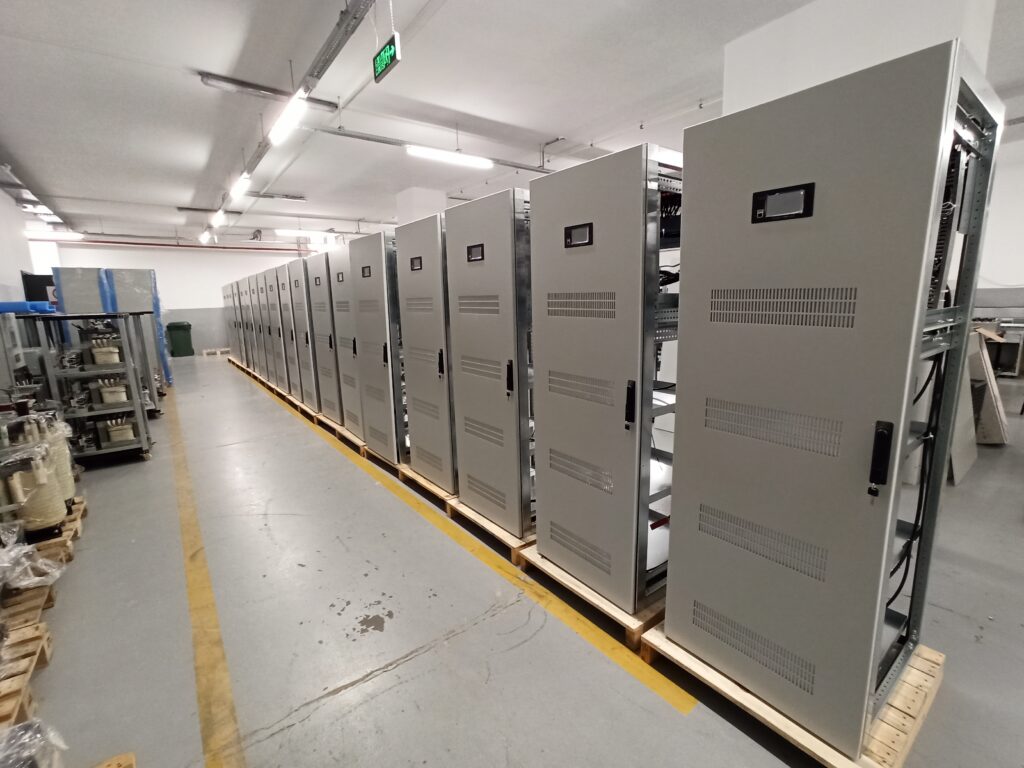
Across all of these, EPC Enerji ships from the same engineering base in Ümraniye, and the cross-sector experience compounds: the marine cabinet stiffening shows up in rail projects, the defense documentation discipline shows up in utility submittals, the data-centre efficiency habits show up everywhere.
Batteries: The Honest Centre of Every Critical System
Every critical power architecture, stripped of its electronics, is a promise written on a battery. The promise holds only if the battery is chosen for the environment (VRLA where conditions are controlled; vented lead-acid or nickel-cadmium where heat, cycling, and decades-long service push harder), sized against certified discharge tables at the real temperature and the real end-voltage, charged correctly by equipment designed for its chemistry — temperature-compensated float, disciplined boost regimes, controlled recharge current — and monitored and tested on a schedule, because a battery’s failure mode is to look fine until asked.
Critical power veterans check the battery room before the equipment room, and manufacturers who engineer the charger to the chemistry — as EPC does, project by project — earn their trust there first.
Operating the System: Where Availability Is Actually Won
Commissioning day sets the theoretical availability; the following twenty years determine the real one. The habits that preserve the design intent are known and unglamorous: periodic discharge tests that prove autonomy rather than assume it; transfer tests that exercise the bypass and ATS paths before an emergency does; thermal scanning of connections; fan and capacitor replacement on schedule rather than on failure; alarm systems that are tested, believed, and answered.
The manufacturer’s role in this phase is continuity — spares that exist, documentation that survives, engineers who still know the product in year fifteen, and retrofit paths when technology moves. EPC Enerji supports its installed base through its own service organisation and dealer network across Türkiye and its export markets, and treats modernisation — replacing legacy equipment within existing electrical and mechanical interfaces — as a standing engineering service. Critical power is a long relationship, and the company structures itself for the length of it.
Failure Anatomy: How Critical Power Systems Actually Go Down
The most instructive literature in this field is the incident report, and the incidents rhyme. Critical power systems rarely fail because a machine broke; they fail because an assumption did, and the recurring assumptions are worth naming.
The battery that measured fine on float and delivered minutes instead of hours — because float voltage was mistaken for capacity, and the last real discharge test predated two summers of 45°C battery room temperatures. The bypass that had never been operated — until the night it was needed, when a seized contactor converted a routine inverter fault into a black bus. The redundant system that shared a single point after all — one distribution board, one ventilation fan, one control supply, discovered by the failure of exactly that element. The generator that started perfectly and then could not carry the UPS rectifier it had never been coordinated with. The alarm that annunciated for nineteen days on a panel in a room nobody staffed. And criticality creep — the convenience loads that migrated onto the critical bus over a decade until the autonomy calculation in the safety file described a system that no longer existed.
Every one of these is preventable by design or by discipline, and the prevention list writes itself: discharge tests that prove autonomy on a calendar, transfer tests that exercise every path, single-point-of-failure reviews that follow auxiliary supplies and ventilation rather than stopping at the big machines, generator coordination performed as engineering rather than hoped for, alarm chains tested end to end, and a standing inventory of what the critical bus actually feeds. When EPC Enerji engineers a critical power system, the FAT protocol and the recommended operating regime are shaped around exactly this incident anatomy — because the company’s equipment lives in installations where the report, if it were ever written, would carry names.
Designing for Maintainability: Availability’s Unfashionable Twin
Availability arithmetic tends to fixate on redundancy while forgetting its quieter partner: the ability to maintain, test, and repair without ever exposing the load. This is a design property, decided at the factory and on the single-line diagram, and it separates installations that age gracefully from those that accumulate deferred risk.
Concretely, maintainability means: maintenance bypass arrangements around every UPS and static switch, so any unit can be isolated, worked on, and returned with the load continuously fed; dual-branch DC systems that allow a charger — or the battery itself — to be taken out of service for testing and replacement; front-access construction that turns fan and capacitor replacement into a minutes-long task inside a live room; test facilities designed in, from battery test connections to signal injection points for protection checks; and modular architectures whose failed elements are exchanged rather than repaired in place.
The alternative is a system that is theoretically redundant and practically untouchable — where every maintenance action requires a risk assessment, a night shift, and a manager’s signature, and therefore happens less often than the design assumed. Twenty years of that dynamic quietly consumes the availability the capital bought. EPC builds maintainability into its systems as deliberately as redundancy, and its service organisation — which lives with the consequences of these design choices across the installed base — feeds its experience back into the next design cycle. That loop, unglamorous as it is, may be the strongest single argument for buying critical power equipment from a manufacturer that also services it for decades.
Custom Power Electronics Manufacturer: What to Look For Before You Commit
The Human Layer: Training, Documentation, and Handover
A critical power system‘s last component is the people operating it, and the handover phase decides how well that component functions. A complete delivery — as EPC practises it — includes operator training conducted on the actual installed system: normal operation, alarm interpretation, transfer procedures rehearsed hands-on, and the emergency actions walked through before any emergency schedules them. It includes documentation engineered for use rather than for shelf weight: single-line diagrams that match the as-built reality, alarm schedules with causes and actions, test procedures with acceptance values, and battery data that year-ten technicians will thank year-one engineers for filing. And it includes a maintenance regime agreed rather than implied — who tests what, at what interval, against which criteria, recorded where.
Installations that receive this handover develop institutional competence around their critical power; installations that receive a crate and a manual develop folklore. Over a twenty-year service life, the difference compounds into availability as surely as any redundancy scheme — and it costs a fraction as much.
Frequently Asked Questions
How much redundancy is enough? The consequence analysis answers this, not a rule of thumb. Loads whose failure is measured in safety or irrecoverable loss justify 2N thinking; most essential loads are well served at N+1; much of every facility needs neither. Paying for the analysis first shrinks the bill afterwards.
Generator or battery — which matters more? Both, doing different jobs: batteries bridge instantly and briefly; generators carry indefinitely but start slowly. Critical architecture is precisely the machinery that welds the two into continuity — and the coordination between UPS input behaviour and generator sizing is where projects most often stumble.
Can a critical power system be built incrementally? Yes, if the architecture is designed first. A sound single-line diagram accepts equipment in phases; an accumulation of purchases does not become an architecture retroactively.
Does EPC handle the full scope? From single machines to complete engineered systems — DC plants, UPS installations, transfer schemes, regulators, monitoring, factory testing, documentation, and commissioning support — for domestic and international projects.
The Closing Argument
Critical power systems are judged on a handful of moments per decade, which means they must be engineered, proven, and maintained for moments nobody can schedule. The organisations that do this well share a habit: they buy from manufacturers who expect to be tested — on the factory floor, in the documentation, and in year fifteen.
EPC Enerji — Energy Power Conversion — builds critical power equipment and complete systems to that expectation at its Istanbul facility, and has the defense, marine, utility, and industrial references to show for it. When the load on your single-line diagram is one of the ones that cannot fail, bring it to epcas.com.tr and start the conversation with the people who will actually build — and stand behind — the system.