

Industrial Rectifier Price Guide: What Affects the Cost of Custom DC Power Systems?

Buyers often send us two rectifier quotations and ask why one costs 40% more than the other. Usually both quotes are honest. They just describe different machines. One includes a 12-pulse transformer, a filter sized for 1% ripple without battery and a witnessed heat run; the other uses a 6-pulse bridge, measures ripple with the battery connected and ships after a functional test. Both say “110 V DC, 100 A”.
This guide explains what goes into the price of a custom industrial rectifier, which specification choices move it most, how to think about lifecycle cost, and what to put in an RFQ so quotes are comparable.
What you’re paying for

The chart shows the indicative share of each cost group in a custom industrial rectifier. The ranges are wide because they depend on voltage, current, topology and options.
Transformer and magnetics (roughly 25–35%). The largest single item in most industrial rectifiers. Line-frequency transformers provide isolation and voltage matching, and 12-pulse or 18-pulse designs need transformers with multiple phase-shifted secondaries. Copper and electrical steel prices feed straight into this line, which is one reason rectifier prices move with commodity markets.
Semiconductors and heat sinks (roughly 10–18%). Thyristors, diodes or IGBTs, plus the heat sinks and fans to cool them. At high currents this share grows, because more devices and larger heat sinks are needed.
Enclosure and busbars (roughly 8–15%). Cabinet, paint, internal copper busbars, terminals. At 1000 A and above, copper busbars become a significant cost.
Engineering and documentation (roughly 8–12%). Design, calculations, drawings, document reviews. Higher for project-specific designs and for clients with detailed document requirements.
Output filter and chokes (roughly 8–12%). Smoothing inductors and capacitors to meet the ripple specification. A tighter ripple requirement means a bigger filter.
Control and communication (roughly 6–10%). Controller, HMI, measurement, protection, communication interfaces.
Testing and FAT (roughly 3–6%). Full-load testing, heat run, ripple measurement, client witness.
The specification is the price

The table lists specification items that push the price up or down. A few deserve more explanation.
Ripple without battery
If you specify 1% rms ripple with the battery disconnected, the output filter must achieve that on its own. Without the battery to absorb ripple, that’s a substantial filter, especially for 6-pulse designs. It’s a legitimate requirement for systems where the battery may be disconnected and sensitive loads remain, but ask whether your loads actually need it. Electroplating, for example, often tolerates several percent.
Redundancy
N+1 modular or 2 × 100% rectifiers roughly double the power hardware cost. For a power plant DC system or a critical process, that’s normal. For a test bench, it probably isn’t needed.
Input harmonics
Utility limits or plant power quality requirements may call for input THDi below a certain level. A 6-pulse rectifier has THDi around 30%; 12-pulse around 10–12%; 18-pulse or an active front end can reach 5% or less. Each step costs more in transformer complexity or power electronics.
Cooling
Forced-air cooling is the default. Water cooling adds a heat exchanger, pumps or plant water connection, and leak detection, but allows a much smaller cabinet and can be essential in hot or sealed environments. It’s not always more expensive overall when space or HVAC is costly.
Enclosure
IP54 or higher, outdoor installation, stainless steel or special paint systems all add cost, partly in the enclosure itself and partly in redesigning the cooling to work inside it.
Standard voltages
Rectifiers at 24, 48, 110, 125 and 220 V DC use proven designs and component sets. Unusual voltages, very wide adjustment ranges or exotic current ratings require more design work. If your load can accept a standard voltage, use it.
A complete, early specification
This is the most powerful cost reducer. Every change after the design starts costs engineering time. Every clarification round adds delay. A complete RFQ lets the manufacturer design once.
How a quote grows
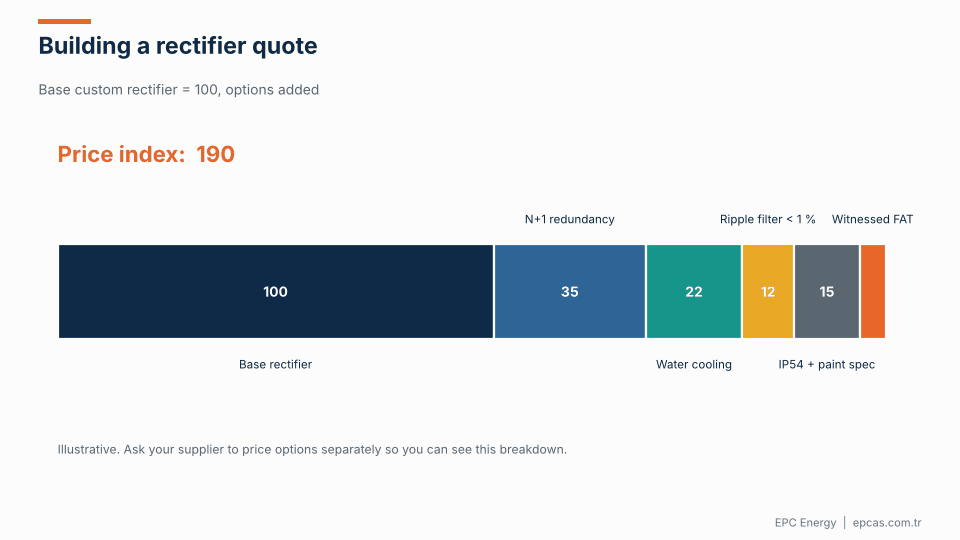
The animation shows how a base custom rectifier (index 100) grows as options are added: N+1 redundancy adds about 35 points, water cooling about 22, a filter for 1% ripple without battery about 12, an IP54 enclosure with a project paint specification about 15, and a witnessed FAT about 6. The total reaches about 190.
These are illustrative values, but the pattern holds in real projects: redundancy and the main topology decisions move the price most, while options like enclosure and testing are smaller additions. Asking suppliers to price options separately makes it much easier to compare quotes and decide what you really need.
Price per kW and economies of scale

Price per kW falls as the rating increases, because engineering, controls, documentation and the enclosure are partly fixed costs spread over more power. The chart shows an illustrative trend for 110 V DC rectifiers.
Two observations:
- Thyristor rectifiers benefit more from scale. A larger thyristor rectifier uses a bigger transformer and larger devices, but not more of them. Cost per kW falls steeply.
- Modular IGBT systems scale more linearly. Adding power means adding modules. The cost per kW falls at first, then flattens.
For small ratings, modular systems can be competitive. For large ratings at a fixed voltage, thyristor designs often have a cost advantage. For large ratings with redundancy, modular systems may win again. It depends on the specification.
Efficiency and lifecycle cost
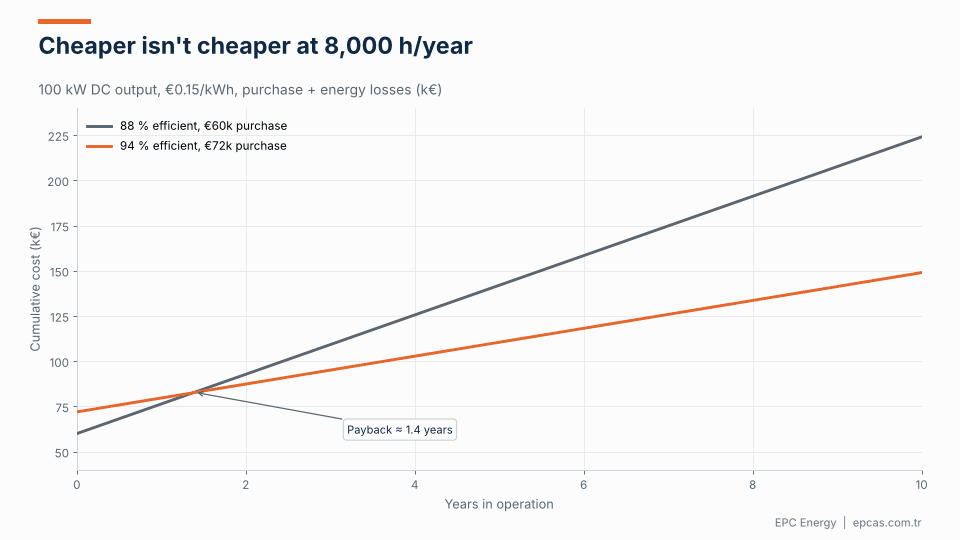
Purchase price is only part of the cost. For rectifiers running continuously at high load, such as electroplating, electrolysis or large DC distribution, energy losses can exceed the purchase price within a few years.
The animation compares two 100 kW rectifiers running 8,000 hours per year, with electricity at €0.15/kWh:
- Rectifier A: 88% efficient, €60,000 purchase price. Losses of about 13.6 kW cost about €16,400 per year.
- Rectifier B: 94% efficient, €72,000 purchase price. Losses of about 6.4 kW cost about €7,700 per year.
Rectifier B costs €12,000 more to buy but saves about €8,700 per year. The payback is about 1.4 years. Over ten years, B is roughly €75,000 cheaper. And lower losses also mean less heat, which reduces HVAC load in the room.
The numbers will be different for your site, of course. But for continuous-duty, high-power rectifiers, it’s worth asking every supplier for efficiency at your actual operating point and running this calculation.
Lead time
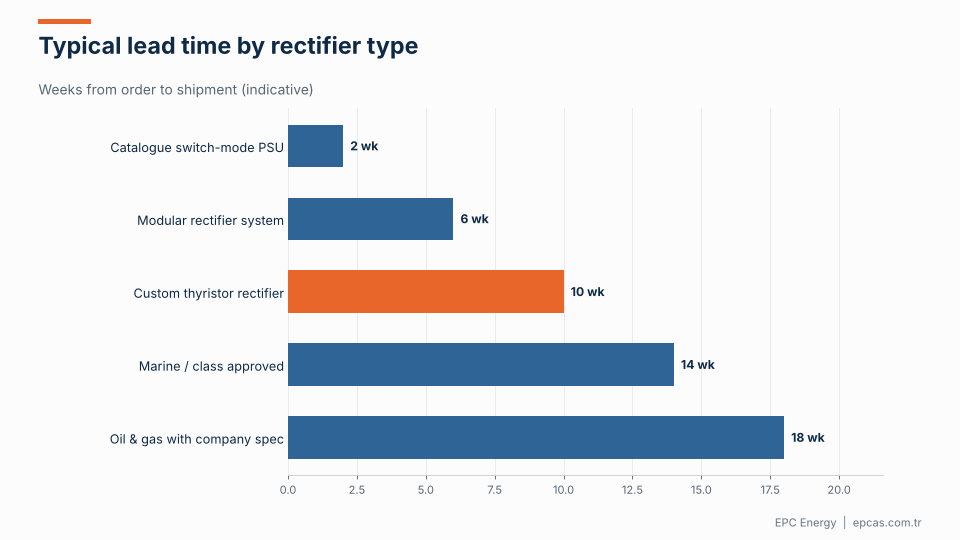
Lead time isn’t a price, but it often affects cost through schedule. The animation shows indicative lead times for different rectifier types:
- Catalogue switch-mode power supplies: often available within a few weeks.
- Modular rectifier systems: commonly 4–8 weeks.
- Custom thyristor rectifiers: commonly 8–12 weeks.
- Marine or class-approved rectifiers: longer, because of class drawing review and witnessed testing.
- Oil and gas rectifiers with company specifications: longest, because of document review cycles, special components and third-party inspection.
These are typical ranges, not commitments. Transformer lead times, component availability and the document approval cycle are the main variables. A complete specification at RFQ stage is the best way to shorten them.
Costs that don’t appear on the quote
The rectifier price is only part of what the project will spend. When budgeting, include the items around it:
Installation and cabling. At high currents, the output cables or busbars to the load can cost a meaningful fraction of the rectifier itself. Shorter runs save both money and losses, so place the rectifier as close to the load as practical.
Room and cooling. Losses become heat. A 100 kW rectifier at 90% efficiency puts around 11 kW into the room. If the room is air-conditioned, that’s HVAC capacity and energy you’ll pay for every year.
Commissioning. Site start-up, settings, integration with the plant control system, site acceptance testing. Clarify whether it’s included and how many days are allowed.
Spare parts. A commissioning spares kit and two-year operational spares are typically quoted separately. For critical systems, budget for them from the start.
Downtime risk. If the rectifier feeds a continuous process, the cost of one day’s lost production may exceed the price difference between a basic and a redundant design.
Thyristor or IGBT: what it means for price
Buyers often ask which technology is cheaper. In broad terms:
- For a single, non-redundant rectifier at moderate current and a standard voltage, a thyristor design is usually the most economical, especially as power rises.
- For tight ripple, low input harmonics or fast dynamic response, IGBT designs can reach the requirement with less filtering and fewer transformer windings, which narrows or reverses the price gap.
- For redundant systems, modular IGBT designs add redundancy one module at a time, while thyristor systems usually need a full second rectifier.
The cheapest technology on paper is not always the cheapest system once the specification is applied. A manufacturer who builds both can price both and show you the trade-off.
Budget estimate or firm quote?
Early in a project, you often need a number before the specification is final. That’s reasonable, and most manufacturers will give a budgetary estimate from a short description: voltage, current, quantity and application. Treat it for what it is, a figure with a tolerance of perhaps ±20–30%, based on assumptions you may not have seen.
A firm quote is different. It’s based on a reviewed specification, lists the assumptions and any deviations, and prices options separately. The jump from budget to firm quote is where surprises appear, usually because the final specification added redundancy, tighter ripple, a company document list or a harsher environment than the budget assumed.
The simplest way to avoid that gap is to ask for the assumptions behind every budget figure, and to send the supplier any specification changes as soon as they’re known.
Comparing quotes: what to check
When comparing rectifier quotations, check that they agree on:
- Output voltage range and current, including any overload rating.
- Ripple, with the same measurement conditions (with or without battery, rms or peak-to-peak).
- Input harmonics (THDi) and power factor.
- Efficiency at your operating point.
- Topology: 6-pulse, 12-pulse, IGBT, modular.
- Redundancy.
- Cooling method and rated ambient temperature.
- Enclosure and IP rating.
- Control and communication
- Testing: scope of FAT, heat run, witness.
- Documentation
- Warranty and spare parts
If one quote is much lower than the others, it usually differs on at least one of these. That might be fine for your application, but you should know.
Industrial rectifier RFQ checklist

Include these in your RFQ:
DC output. Nominal voltage, adjustment range, continuous current, overload current and duration, regulation accuracy, operating mode (constant voltage, constant current, or both).
Load type. Battery (chemistry, cells, capacity), resistive, electrolytic, motor, capacitive. Each behaves differently.
Ripple limit. Value, rms or peak-to-peak, with or without battery.
AC input. Voltage, phases, frequency, tolerances, harmonic limits, short-circuit level if known.
Duty cycle. Continuous, intermittent, cyclic, with typical load profile.
Cooling and site. Air or water cooling; ambient temperature range; altitude; humidity; indoor or outdoor; IP rating.
Control and communication. Local HMI, remote setpoints, protocols (Modbus, Profinet, IEC 61850), alarm contacts.
Quantity and schedule. Number of units, delivery date, FAT requirements, documentation needs.
Frequently asked questions
How much does an industrial rectifier cost?
It depends on output power, voltage, current, topology, ripple and harmonic requirements, redundancy, cooling, enclosure and documentation. For the same output rating, these choices can change the price significantly. The most accurate way to get a price is to send a complete specification.
Why are custom industrial rectifiers more expensive than catalogue power supplies?
Industrial rectifiers use line-frequency isolation transformers, are designed for continuous duty over 20 years or more, tolerate harsh supplies and environments, meet project-specific requirements and come with engineering documentation and full-load testing.
Is a more efficient rectifier worth the extra cost?
For rectifiers running continuously at high load, often yes. A few percent of efficiency can save more in energy than the price difference within one or two years. Run the lifecycle calculation with your operating hours and electricity price.
What increases the cost of an industrial rectifier the most?
Redundancy, low ripple without battery, low input harmonics, water cooling, high IP ratings and project-specific documentation and testing. The main topology decision (6-pulse, 12-pulse, IGBT) also affects the price significantly.
How long does it take to manufacture a custom industrial rectifier?
Typical lead times range from around 4–8 weeks for modular systems to 8–12 weeks or more for custom thyristor rectifiers, and longer for class-approved or oil and gas projects with extensive documentation and inspection requirements.
Get a precise rectifier quote
EPC Energy designs and manufactures custom industrial rectifiers from a few amperes to over 1200 A, in thyristor and IGBT topologies, for telecom, power plants, marine and industrial processes. Every unit is built and tested in our Istanbul facility. Send your specification to epcas@epcas.com.tr and our engineers will return a detailed proposal, with options priced separately so you can see exactly what you’re paying for.