

What is Industrial Inverter
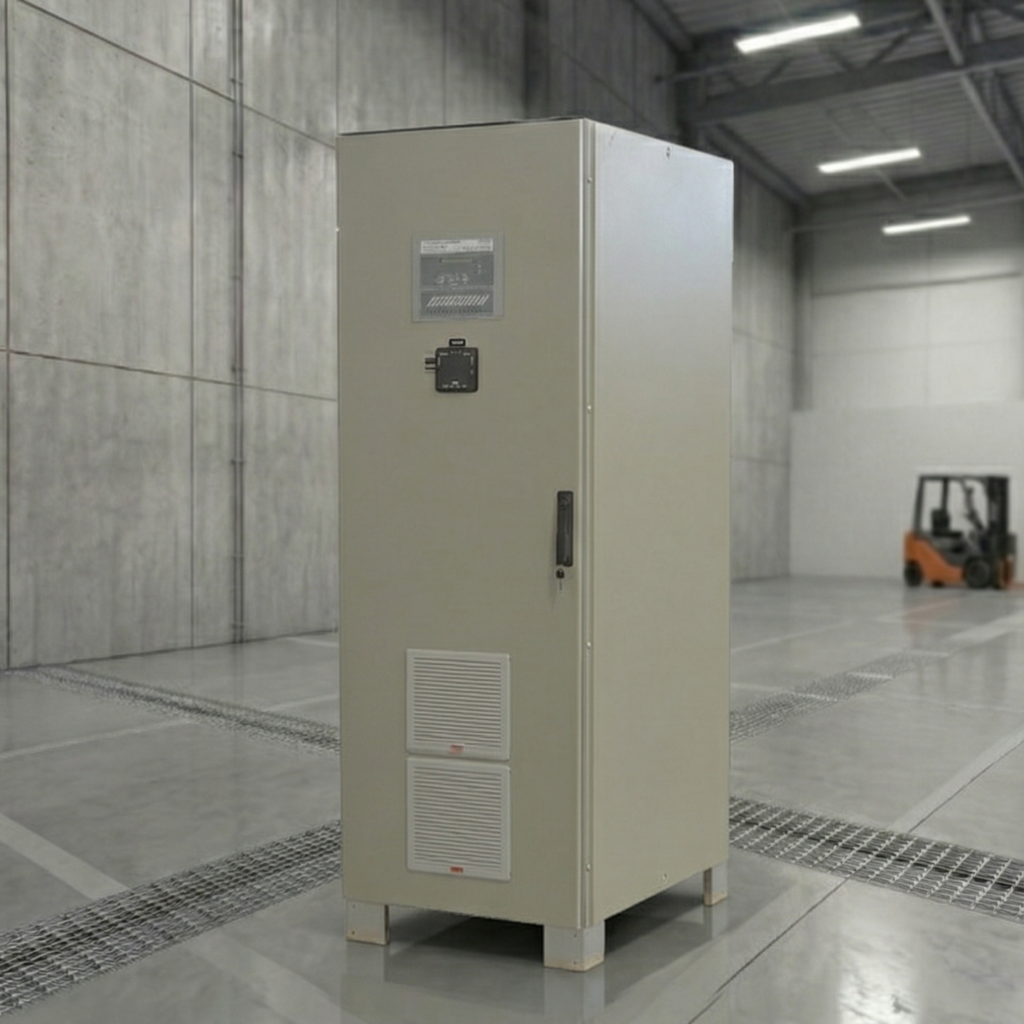
Walk through the switchgear room of a modern facility and count the loads that would happily run on the raw grid alone. There are fewer than most people assume. Somewhere between the battery bank, the solar array, the shore connection, or the DC bus of a traction substation, a device has to take direct current and turn it into clean, stable alternating current that motors, control systems, and instrumentation can actually trust. That device is the industrial inverter, and the difference between a good one and a barely adequate one usually stays invisible right up until the day it matters.
Industrial Transfer Switch: How ATS and STS Systems Keep Critical Loads Running
Consumer and light-commercial inverters have become commodities. Industrial inverters have not, and for good reason. A unit feeding navigation equipment on a vessel in the Black Sea, a telecom repeater on a mountain ridge, or the emergency lighting bus of a refinery is not living in a climate-controlled office. It is living with salt mist, vibration, dust, 55°C panel interiors, harmonics-rich source voltage, and loads that inrush at six times their nameplate current without warning. Designing for that world is a different discipline, and it is the discipline EPC Energy has built its industrial inverter range around at its manufacturing facility in Istanbul.
What Separates an Industrial Inverter from Everything Else on the Market
The datasheet numbers that get compared in procurement meetings — output kVA, efficiency percentage, THD figure — are the easy part. Almost every serious manufacturer can print respectable values in those boxes. The industrial character of an inverter shows up in the specifications people forget to ask about.
Overload behaviour is the first. A commercial unit typically tolerates 110% load for a few seconds before folding back or tripping. Industrial loads do not extend that courtesy. A pump motor starting direct-on-line, a transformer energising, a bank of contactors pulling in together — these events demand short bursts of several times rated current. An industrial inverter is sized and thermally designed to ride through them, delivering typically 150% for tens of seconds and much higher instantaneous peaks, then settling back without a hiccup on the output waveform.
Galvanic isolation is the second. Many low-cost topologies are transformerless, which is fine on a rooftop and unacceptable on a DC bus shared with battery chargers, rectifiers, and field instrumentation. An isolation transformer inside the inverter breaks ground-fault paths, blocks DC injection into the load side, and keeps a single wiring fault from cascading through the plant. EPC builds its industrial inverter systems with proper output isolation as standard where the application calls for it, because retrofitting isolation after a fault event is a lesson nobody wants to pay for twice.
Input tolerance is the third. Battery-fed inverters in substations and telecom sites see their DC input swing across the full charge-discharge window — a nominal 110 VDC system can legitimately sit anywhere from roughly 88 to 140 VDC depending on float, boost, and end-of-discharge conditions. The inverter must hold its output voltage and frequency rock-steady across that entire span, not merely at nominal.
Then there is the environmental layer: conformal-coated boards for humid and saline atmospheres, reinforced mechanical construction for rail and marine vibration profiles, wide operating temperature ranges, and enclosure protection classes matched to the installation site rather than to a laboratory. These are exactly the parameters EPC Enerji engineers against, because the company’s inverters ship into transportation, marine, defense, oil and gas, and energy projects where the environment is part of the specification, not a footnote.
Where Industrial Inverters Earn Their Keep
It helps to look at the actual jobs these machines do, because the application shapes the design far more than any general standard does.
Substations and Power Plants
Every transmission substation and generating station carries a station battery — the DC system that keeps protection relays, breaker trip coils, and SCADA alive when the grid itself is in trouble. But plenty of essential equipment in those same buildings needs AC: emergency lighting, communication racks, operator workstations, cooling for control rooms. The industrial inverter bridges the two worlds, drawing from the station battery and producing utility-grade AC that keeps the human and control layers of the plant functional during exactly the events the plant exists to manage. EPC supplies inverter systems for power plant and substation duty with the redundancy options — parallel operation, static transfer to a reserve source, hot-swappable configurations — that this class of installation demands.
Custom Power Electronics Manufacturer: What to Look For Before You Commit
Marine and Shipboard Systems
A ship is an island grid with an attitude problem. Generator frequency wanders with engine load, voltage dips when thrusters engage, and everything on board vibrates constantly. Navigation electronics, radio equipment, and safety systems cannot tolerate that instability, so they run from inverters fed by the ship’s battery banks. Marine-duty inverters from EPC Enerji are built for classification requirements, salt-laden air, and the mechanical abuse of a working vessel — a segment the company knows well through its marine and shipbuilding references.
Rail and Traction Applications
Rolling stock and trackside infrastructure live on DC — 24, 72, 110, 750, or higher volt systems depending on the network. Passenger information displays, ventilation, signalling ancillaries, and onboard sockets all want AC. Traction-environment inverters must shrug off the transients of a DC network that regenerative braking regularly hammers, and they must do it inside the vibration and temperature envelope of a moving train. This is custom-engineering territory, and it is precisely the kind of project-specific design work EPC’s engineering team takes on rather than forcing a catalogue unit into a role it was never shaped for.
Solar and Renewable Integration
On the renewable side, the inverter is the entire interface between generation and use. Industrial solar installations — pumping stations, remote facilities, hybrid diesel-solar microgrids — need inverters that coordinate with batteries and generators, handle asymmetric loads, and keep supplying a plant even when the irradiance curve refuses to cooperate. EPC Enerji’s solar solutions portfolio pairs this inverter capability with the company’s broader power conversion experience, which matters when the “solar project” is really a complete plant energy system wearing a solar badge.
Reading a Specification Like an Engineer, Not a Buyer
If a procurement package for an industrial inverter is being written or evaluated, a handful of questions cut through marketing language faster than anything else.
- What is the output waveform quality under nonlinear load — not resistive test load? Rectifier-front-end loads (which is to say, nearly all modern electronics) distort weak inverters badly. Ask for THD figures at realistic crest factors.
- How does the unit behave at short-circuit on the output? A well-designed industrial inverter delivers controlled fault current long enough to trip downstream breakers selectively, then protects itself. A poor one simply shuts down and takes the whole bus with it.
- What is the transfer arrangement? Many critical installations pair the inverter with a static switch and a bypass line, so a failed inverter hands the load to reserve mains in a few milliseconds. Whether that switch is internal, external, manual, or static changes the availability calculation completely.
- What happens at end of battery discharge? Orderly shutdown with alarm signalling is a design decision, not an accident.
- Can the manufacturer show type tests and project references in your sector? A unit proven in defense or oil and gas programmes has survived documentation and inspection regimes that reveal weaknesses generic products never face.
EPC Energy‘s answers to these questions are grounded in the fact that the company designs and manufactures its power conversion equipment itself. When a specification calls for an unusual DC window, a specific signalling interface, parallel-redundant modules, or compliance evidence for a demanding end client, the conversation happens with the engineers who will actually build the unit — in Istanbul, not through three layers of distribution.
The Custom Question: When the Catalogue Is Not Enough
A recurring pattern in industrial projects goes like this: the electrical consultant writes a requirement around the real installation — say, 110 VDC input, 3×400 VAC output, 20 kVA, marine type approval, seismic bracing, front-access only because the cabinet sits against a bulkhead. Distributors respond with the nearest standard product and a list of deviations. The deviations then become the project’s problem.
A manufacturer with genuine engineering depth inverts that dynamic. EPC Enerji regularly builds inverters to project specification: non-standard voltages and frequencies, unusual form factors, extended environmental ratings, customer-specified components and protection philosophies, and documentation packages shaped to the approval authority — whether that authority is a marine classification society, a defense quality organisation, or a national grid operator. The company’s export track record across dozens of countries reflects exactly this ability to meet the specification as written rather than negotiating it downward.
Custom does not mean slow or exotic, either. It means the isolation transformer is wound for the actual input window, the heatsinks are sized for the actual ambient, and the alarm contacts speak the actual SCADA protocol on site. Over a twenty-year service life, that alignment is worth far more than a marginal difference in purchase price.
Efficiency, Heat, and the Cost Nobody Puts in the Tender
Every percentage point of inverter loss is paid twice: once as wasted energy, and again as heat that the room’s cooling system must remove. In a telecom shelter or a ship’s electronics compartment, the second payment is often larger than the first. Modern IGBT-based designs with optimised switching strategies keep industrial inverter efficiency in the mid-nineties even at partial load — and partial load is where most units actually spend their lives, because sound engineering practice sizes them with headroom.
This is also why lifecycle thinking belongs in the purchase decision. Fans and DC-link capacitors are ageing components with predictable service intervals; a unit designed for maintainability lets a technician replace them in minutes through front access, while a poorly laid-out one turns the same task into a shutdown. EPC backs its equipment with a dealer and service network and with spare-part continuity that comes naturally to a company supporting installations across power plants, transport networks, and industrial facilities that measure their planning horizons in decades.
A Practical Word on Sizing
Three habits prevent most inverter sizing mistakes. First, size on the worst realistic combination of continuous load plus the largest single starting event, not on a summed nameplate list padded with a generic safety factor. Second, respect crest factor: electronic loads draw peaky current, and an inverter rated 10 kVA for sinusoidal loads may be working much harder than the wattmeter suggests. Third, decide the redundancy philosophy before choosing the frame size — an N+1 arrangement of smaller parallel modules often beats one large monolith on both availability and future flexibility. EPC’s application engineers routinely work through these trade-offs with customers at the proposal stage, because a correctly framed question at that point costs nothing and a wrongly framed one costs a change order.
Standards, Approvals, and the Paper That Travels with the Machine
Industrial inverters rarely live in unregulated space. Utility installations answer to grid codes and national electricity authority requirements. Marine units carry classification society approvals, with type tests covering vibration, inclination, temperature, humidity, and electromagnetic compatibility to maritime standards. Defense programmes reference military environmental and EMC standards and audit the manufacturer’s quality system as thoroughly as the product. Rail projects bring their own family of standards for rolling stock and trackside electronics — shock, vibration, temperature cycling, and the notoriously strict EMC environment of a traction network.
For the buyer, two practical consequences follow. The first is that certification must be checked against the actual installation, not assumed from a CE mark; a general industrial approval says nothing about performance on a heaving ship or beside a 25 kV catenary. The second is that the manufacturer’s ability to produce evidence — type test reports, routine test protocols, material traceability, declaration packages formatted for the approving authority — is part of the product. Projects have stalled for months at documentation review while perfectly functional hardware sat in a warehouse.
EPC Enerji’s position here is shaped by the customers it grew up with. Supplying defense, marine, and utility programmes means the company’s engineering office produces submittal packages, test protocols, and compliance matrices as routine deliverables, and hosts witnessed factory acceptance tests at its Istanbul facility as standard practice. A commercial customer buying a single inverter inherits the same documentation culture — which tends to be appreciated most at the exact moment an auditor, an insurer, or an end client’s inspector asks for the file.
A Commissioning Story, Compressed
It is worth walking through how a well-run inverter project actually unfolds, because the sequence itself is a quality signal when comparing suppliers.
It begins with the load list and the DC system definition: what must run, for how long, from what battery, in what environment. The manufacturer’s application engineer converts this into a sizing proposal — continuous rating, overload profile against the largest starting event, battery end-voltage behaviour, heat load for the room — and flags the decisions the customer still owns: transfer scheme, redundancy level, alarm interfaces. Drawings follow and are approved before production, so the cable entries, terminal sizes, and signal lists match the site instead of surprising it.
Then comes the factory acceptance test — the point of the whole exercise. The inverter runs at full load until temperatures stabilise, steps through overload and short-circuit tests, demonstrates transfer to bypass and back, and shows its behaviour across the full DC input window while the customer’s engineer watches the instruments. Whatever ships afterwards has already proven itself once. Site commissioning becomes verification rather than discovery: insulation checks, interface tests against the real SCADA, a battery discharge to confirm autonomy, and formal handover with the documentation file complete.
Every step of that sequence is standard procedure at EPC. None of it is exotic — it is simply what buying from a manufacturer, rather than through a chain of intermediaries, looks like in practice.
Common Mistakes Worth Avoiding
A short catalogue of the errors that generate most inverter service calls, offered in the spirit of prevention. Sizing on nameplate sums instead of realistic demand and starting events — the unit is either twice too large (wasting capital and running at poor partial-load efficiency) or too small at the one moment it matters. Ignoring the DC window — an inverter specified at nominal battery voltage that drops out at end-of-discharge has failed at its only job. Skipping isolation to save cost on a shared DC bus, then spending multiples of the saving diagnosing circulating ground faults. Installing a cabinet designed for 40°C in an unventilated 55°C room and wondering about fan life. And treating alarm outputs as optional wiring, so the first notice of trouble arrives as a dead bus instead of a dry contact three weeks earlier.
None of these mistakes survives a competent application review, which is the strongest practical argument for involving the manufacturer’s engineers before the purchase order rather than after the incident. EPC’s team does this review as a matter of course on every enquiry that arrives with enough information to review — and asks the missing questions when it does not.
Frequently Asked Questions
What is the typical service life of an industrial inverter? With scheduled replacement of fans and electrolytic capacitors, well-built units routinely serve 15–20 years. Environment is the dominant variable; temperature and dust shorten lives faster than load does.
Can an industrial inverter run motors directly? Yes, provided it is sized for the starting current and the motor type is considered. For dedicated motor speed control, a variable frequency drive is the right tool; for feeding a distribution bus that happens to include motors, a properly rated inverter is exactly what is needed.
Do I need galvanic isolation? If the inverter shares a DC source with other equipment, feeds safety-related loads, or operates in marine, rail, or industrial plant environments — almost certainly yes. When in doubt, isolate.
Can existing installations be upgraded rather than replaced wholesale? Frequently. EPC Enerji engineers modernisation projects where a legacy inverter is replaced within the existing electrical and mechanical interfaces, keeping cabling, breakers, and footprint intact.
Talking to a Manufacturer Instead of a Middleman
An industrial inverter is not a purchase; it is a twenty-year relationship with a piece of equipment standing between your critical loads and darkness. That relationship goes better when the party on the other side of it designed the machine, built it, tested it, and will still be answering the phone when a capacitor bank comes due for replacement in year twelve.
EPC Energy — Energy Power Conversion — manufactures industrial inverters, rectifiers, UPS systems, and frequency converters at its facility in Ümraniye, Istanbul, and ships them into transportation, marine, defense, telecommunications, oil and gas, and energy projects across a growing list of exported countries. If a project on your desk needs DC turned into AC that can be trusted without a second thought, send the specification to the EPC engineering team through epcas.com.tr and let the conversation start from your requirements rather than from a catalogue page.