

What is Three Phase Voltage Regulator?

Voltage problems rarely introduce themselves honestly. They arrive disguised as other people’s failures: motors that run hot for no reason, LED lighting replaced twice a year, drives that trip at the same hour every afternoon, welds that vary from shift to shift, a CNC machine that throws alarms whenever the compressor next door starts. Maintenance chases each symptom separately, sometimes for years, before somebody finally puts a recorder on the incoming supply and finds the real culprit — mains voltage wandering far outside the band the equipment was designed for.
This is the problem the three phase voltage regulator exists to solve, at the single point where it can be solved for the whole facility at once. It is one of the oldest categories in power conditioning and one of the most quietly effective, which is why EPC Enerji continues to design and manufacture three phase voltage regulators at its Istanbul facility for factories, hospitals, telecom sites, and infrastructure projects across Türkiye and the many countries it exports to.

Where Bad Voltage Comes From
Grid voltage is a promise with tolerances, and in large parts of the world the tolerances are aspirational. Long rural feeders drop voltage under load and overshoot at night when the load disappears. Industrial zones share transformers with neighbours whose furnaces, welders, and compressors yank the local voltage around by the minute. Rapidly built regions outgrow their distribution infrastructure faster than utilities reinforce it. Seasonal irrigation or tourism loading swings entire networks between undervoltage summers and overvoltage winters. And on-site, a facility’s own large motors and rectifier loads distort what the utility delivers before it ever reaches the sensitive equipment.
The result, measured at real plant terminals, is routinely ±15% or worse — against equipment designed, certified, and warranted for ±10% at best. The damage mechanisms are well understood: undervoltage makes motors draw more current for the same torque, overheating windings and shortening insulation life; overvoltage saturates magnetics and stresses power supplies and lighting; unbalance between phases — a specifically three-phase disease — creates negative-sequence currents that heat motors dramatically out of proportion to the imbalance percentage. None of it fails equipment today. All of it shortens equipment life every hour it continues.
What a Three Phase Regulator Actually Does
A voltage regulator stands between the incoming supply and the load and holds its output voltage within a tight band — typically ±1% to ±2% — while the input swings across a wide window, commonly −25% to +15% or wider on request. Three-phase industrial units regulate each phase independently, which is the crucial point: real networks are unbalanced, and a regulator that corrects only the average would leave the unbalance untouched. Independent per-phase regulation corrects both level and balance simultaneously.
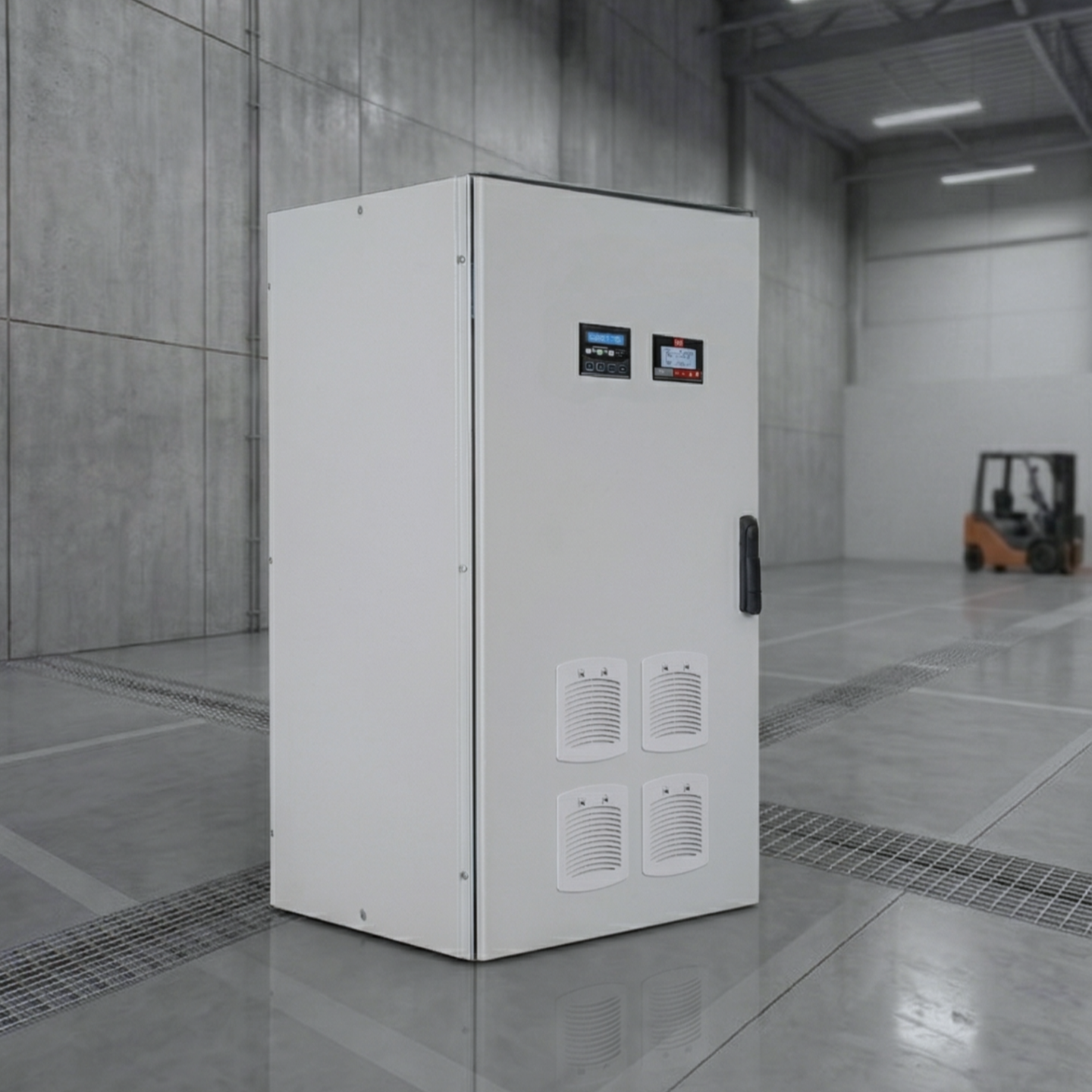
Inside the enclosure, the dominant industrial technology remains the servo-controlled variable transformer: a motor-driven system adjusts transformer ratio continuously and smoothly, feeding a buck-boost stage that adds or subtracts the correction voltage. The virtues that keep this architecture in service after decades are exactly the ones industry values — genuine sine-wave transparency (the load sees the grid waveform, corrected, not a synthesised approximation), massive overload tolerance, indifference to load power factor and nonlinearity, high efficiency because only the correction fraction is processed, and mechanical honesty that plant electricians can understand and service.
What Are Industrial Rectifier Systems? Applications, Benefits & Types
Static (electronic tap-switching) regulators trade the moving parts for speed, stepping between transformer taps in milliseconds using semiconductor switches. Where load steps are violent and correction speed dominates, they earn their place. EPC Enerji manufactures servo-controlled regulator systems across a wide power range and advises on technology per application — because the right answer depends on the load, the disturbance profile, and the environment, not on a brochure.
Sizing and Specifying Without Regret
Most regulator disappointments trace back to specification shortcuts, and they are all avoidable.
- Measure before specifying. A week of recording at the incoming terminals — minimum, maximum, unbalance, and the daily pattern — turns the input range from a guess into a fact. A regulator specified for −20% on a feeder that actually sags to −28% on summer afternoons will spend those afternoons at its limit.
- Size for current, not just kVA. At −25% input, the regulator draws roughly a third more input current to deliver rated output. Undersized units fail at exactly the low-voltage moments they were bought for. Proper industrial designs — EPC’s included — rate the machine for full output across the entire input window.
- Respect the starting loads. Motors on the output demand their inrush through the regulator. Servo-type units tolerate this well, but the sizing must acknowledge it.
- Decide per-phase independence explicitly. For any facility with single-phase loads distributed across a three-phase supply — which is nearly every facility — independent phase regulation is the difference between solving the problem and relocating it.
- Specify the bypass. A manual (and where needed, automatic) bypass lets the plant run unregulated during maintenance rather than dark. It costs little at build time and everything as an afterthought.
- State the environment. Ambient temperature, dust, humidity, altitude, and enclosure protection class belong in the order, because they set the thermal design. EPC builds regulators for electrical rooms, containers, and harsh field sites alike, with enclosure and cooling matched accordingly.
Applications Where Regulators Change the Arithmetic
Manufacturing plants put regulators ahead of CNC parks, injection moulding halls, textile machinery, and packaging lines — anywhere precision equipment meets imperfect supply. The payback arrives as fewer drive trips, longer motor life, and process consistency that quality departments can measure.
Medical imaging is a classic case: MRI, CT, and X-ray systems specify tight supply tolerances, and hospital feeders rarely deliver them naturally. A regulator is frequently a condition of the imaging vendor’s warranty.
Telecommunications and broadcast sites sit at the ends of long feeders by the nature of coverage, precisely where voltage behaves worst. Regulators ahead of the rectifier plant stabilise the whole site — an application EPC knows through its telecommunications sector work.
Water and irrigation pumping stations combine big motors with weak rural networks; regulation protects the pumps and, just as valuably, keeps them delivering rated flow when the grid sags.
Export-grade infrastructure projects — hotels, hospitals, industrial estates, defense facilities in regions with stressed grids — routinely include facility-scale regulators in the electrical design from day one. This is a significant share of EPC Enerji’s regulator business across its exported countries, delivered alongside the company’s UPS, rectifier, and converter ranges as part of complete power quality packages.

Regulator, UPS, or Both? Placing Each Machine Correctly
A voltage regulator and a UPS answer different questions, and mature installations often use both, deliberately placed. The regulator corrects continuous voltage deviation efficiently at facility scale — but it cannot bridge an interruption; when the mains disappear, so does its output. The UPS bridges interruptions and disturbances completely — but deploying double-conversion UPS capacity across an entire facility just to fix chronic voltage levels is an expensive way to solve a cheap problem.
The economical architecture regulates the whole facility and reserves UPS protection for the loads that genuinely cannot tolerate any interruption. The regulator then also serves the UPS itself, keeping its rectifier and batteries inside their comfortable input window and extending their lives. Because EPC Enerji manufactures both machines — and the rectifiers, inverters, and static transfer systems that accompany them — its engineers design these architectures as one system, matched at the interfaces, rather than as products meeting for the first time on site.
Ownership Over Twenty Years
Servo-controlled regulators are long-service machines. The consumables are known and modest: brush assemblies on the variable transformer at multi-year intervals, servo mechanism inspection, ventilation cleaning, and periodic verification of regulation accuracy. A well-built unit runs for decades — plants across Türkiye and the wider region are full of regulators older than the engineers maintaining them — provided the manufacturer engineered honestly and remains reachable.
That last clause deserves weight in the buying decision. A regulator is infrastructure; buy it from an infrastructure-minded company. EPC Enerji manufactures at its own facility in Ümraniye, Istanbul, tests with customers present, documents to the standards its defense, marine, and utility clients require, and supports the installed base through its dealer and service network. Year-twelve spare parts are a stock question, not an archaeology project.
Industrial Frequency Conversion: Connecting 50 Hz, 60 Hz and 400 Hz Systems Efficiently
A Diagnosis Story: How Voltage Problems Actually Get Found
The typical regulator project does not begin with a specification; it begins with a mystery, and the diagnostic path is worth describing because it is the path most facilities will actually walk.
A textile plant, in this composite but entirely representative case, had normalised a pattern of afternoon drive trips on its air-jet looms — attributed variously to the drives, the looms, the operators, and the weather. Motor rewinds ran well above industry norms. The compressor house had burned through soft-starter boards twice in a year. Each symptom had an owner, a workaround, and a budget line; nobody owned the pattern.
The pattern surfaced when a week-long power quality recording finally went onto the incoming supply. The numbers told a complete story: nominal voltage in the small hours, a slow sag through the morning as the industrial zone loaded up, phase-to-phase unbalance exceeding three percent whenever a neighbouring facility’s furnace ran, and afternoon minima fourteen percent below nominal — precisely coincident with the loom trips. The equipment had never been faulty. It had been telling the truth about its supply, in the only language it had.
Custom Power Electronics Manufacturer: What to Look For Before You Commit
The remedy was a servo-controlled three phase regulator with independent phase regulation at the main distribution board, sized on the recorded demand with the input window set from the recorded minima plus margin — not from the utility’s nominal promise. The trips stopped the week it was commissioned. Rewind frequency fell over the following year to unremarkable levels. The plant’s engineering manager, asked later what the regulator had cost, gave the only correct answer: less than the previous year’s symptoms.
Two lessons travel well from this story. Measurement precedes specification — the recording is the specification’s raw material. And the regulator’s return on investment hides in maintenance ledgers and scrap rates, not on the electricity bill, which is why finance departments approve these projects fastest when the symptom costs are gathered honestly first. EPC Enerji’s application engineers regularly help customers assemble exactly that picture at the enquiry stage, because a well-founded project is easier to build than a hopeful one.
Inside the Machine: What Quality Looks Like in a Servo Regulator
Since servo-controlled regulators from different manufacturers can look identical in a brochure, it helps to know where build quality actually resides. The variable transformer is the heart: the quality of its winding, the brush material and contact system, and the thermal design determine whether the machine shrugs off twenty years of continuous adjustment or wears its way to a service contract. The buck-boost transformer’s sizing sets the genuine correction capability at the input extremes — an undersized booster meets its specification at nominal and quietly fails it at the corner cases the machine was bought for. The servo drive and control electronics decide correction smoothness, hunting behaviour under fluctuating load, and the machine’s manners when the input oscillates around a threshold. Protection philosophy — overcurrent, over-temperature, output over/undervoltage with configurable trip and alarm behaviour, and the bypass logic — decides what happens on the machine’s worst day.
Power Plant Internal Consumption (Egypt) – 30kVA Static Voltage Regulator Design and Manufacturing
None of this is visible at tender stage except through proxies: the manufacturer’s willingness to state performance at the input extremes rather than at nominal, the mass of copper and iron per kVA (regulators are one field where weight still correlates with honesty), the availability of type test reports, and the offer of a witnessed load test. EPC Enerji manufactures its regulators around exactly these quality centres at its Istanbul facility and load-tests them before dispatch — with customers welcome at the test bay, which is a standing policy across the company’s product range and, in this market, a usefully clarifying one.
Regulators in the Export Project Context
A final word on a context where regulators carry particular weight: international projects in regions with stressed grids. Contractors building hospitals, hotels, industrial facilities, and infrastructure across the Middle East, Africa, Central Asia, and beyond have learned to write facility-scale regulation into the electrical design from the outset, because commissioning sensitive equipment on a weak grid without it means warranty disputes in three languages. For these projects the regulator arrives as part of a coordinated power package — regulator, UPS, DC systems, generator coordination — with export documentation, conformity certificates, and factory test records assembled for the destination authority. This is a substantial share of EPC Enerji’s regulator output: engineered in Istanbul, tested with the contractor’s representative present, and shipped with the paper trail that lets a site thousands of kilometres away commission on schedule. The company’s exported-countries list has been built one such project at a time.
Industrial Frequency Conversion: Connecting 50 Hz, 60 Hz and 400 Hz Systems Efficiently
A final placement note for designers: the regulator’s position in the single-line diagram deserves a moment’s deliberate thought. Whole-facility regulation at the main board is the economical default, but some installations do better with targeted placement — a dedicated regulator ahead of a sensitive machine park, a medical imaging suite, or a laboratory, leaving robust loads on the raw supply. The deciding factors are the geography of the sensitive loads, the cost per kVA at each candidate size, and the fault-level and selectivity consequences at each position. Mixed strategies are legitimate too: facility-scale regulation for the chronic problem plus local conditioning for the exceptional load. These are twenty-minute conversations with an application engineer that shape twenty years of operation, and EPC Enerji’s team has them at the enquiry stage as a matter of routine, before any frame size enters the discussion.
The Practical Next Step
If equipment failures in a facility keep clustering around no visible cause, the incoming voltage deserves a week of honest measurement — and if the recording shows what it usually shows, a properly sized three phase voltage regulator will repay itself in motor life, uptime, and process consistency for decades. Send the measurements, the load list, and the site conditions to EPC Enerji through epcas.com.tr; the engineering team in Istanbul will size, build, and test the machine for the installation it will actually protect.