

Industrial Power Supply Solutions: Designing Power as a System, Not a Shopping List
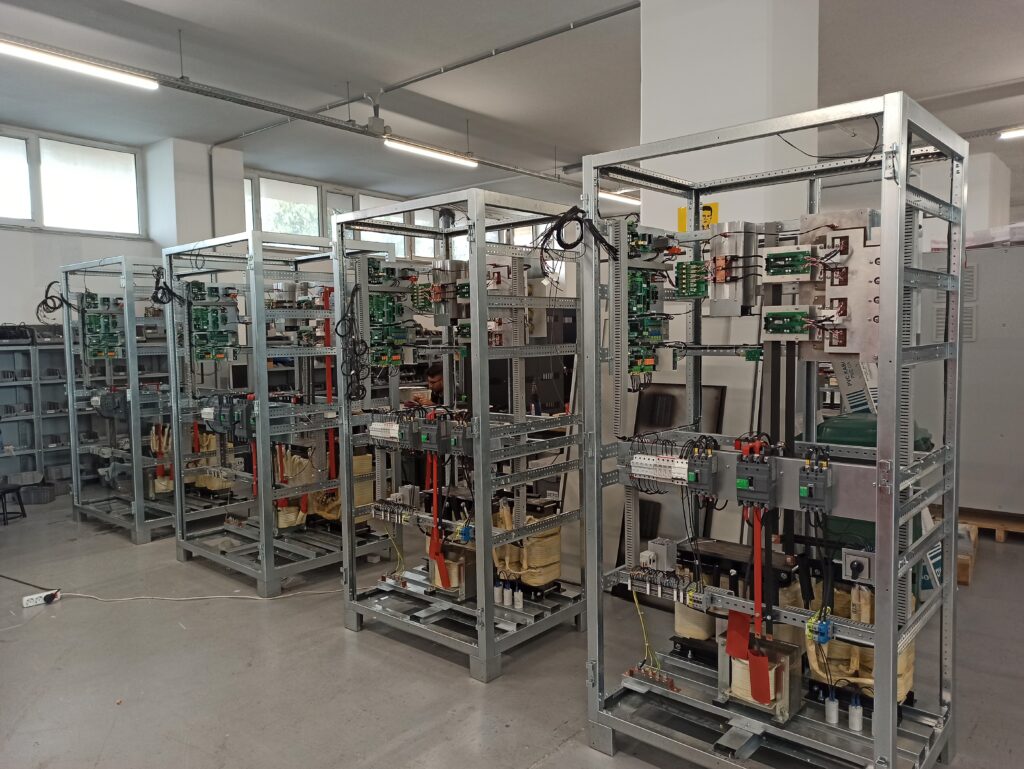
Every industrial facility eventually accumulates a power supply architecture. The question is whether anyone designed it. Walk through a typical plant that grew organically and you will find the archaeology: a UPS bought for the server room in one decade, a battery charger added with the substation in another, a voltage regulator installed after a bad summer, an inverter wedged in when a new line arrived from abroad — each purchased separately, from a different vendor, sized to its own moment, and connected by assumptions nobody ever wrote down.
It works, mostly, until the day the interactions matter: the generator that cannot start the UPS rectifier, the two DC systems with incompatible earthing philosophies, the alarm contacts that speak three different protocols to a SCADA that understands one. Industrial power supply solutions — the phrase taken seriously — means treating all of it as one engineered system, and it is the level at which EPC Enerji prefers to work. The company’s name, Energy Power Conversion, describes a portfolio built for exactly this: rectifiers, inverters, UPS systems, frequency converters, voltage regulators, and transfer systems designed under one roof in Istanbul so they can be designed to work together.
The Layers of an Industrial Power Architecture
A complete plant power supply solution is really four problems stacked on top of each other, and each layer has its own machinery.
Continuity answers the question: what happens when the mains fail? The tools are the DC systems — rectifier-charger and battery — that hold protection, control, and communication alive; the industrial UPS systems that keep AC-fed critical loads running through the gap; and the transfer switches, static and automatic, that move loads between sources faster than the loads can notice. Autonomy times, redundancy schemes, and generator coordination are the design variables.
Quality answers: what happens when the mains are present but wrong? Voltage regulators correct chronic level and unbalance problems at facility scale; double-conversion UPS topology manufactures clean power for the loads that cannot tolerate anything less; isolation transformers break fault paths and decouple earthing schemes.
Compatibility answers: what happens when equipment and supply disagree by design? Frequency converters bridge 50, 60, and 400 Hz worlds for imported machinery, ships at berth, defense systems, and test laboratories; special voltage and custom conversion equipment adapts whatever the project imported to whatever the site provides.
Conversion for the process itself covers the loads where power electronics is the process: high-current DC for electroplating and electrolysis, controlled supplies for laboratories and test benches, solar conversion tying renewable generation into the plant’s energy balance.
Buy these layers separately and each purchase optimises itself. Engineer them together and the architecture optimises the plant — which is a different and considerably more valuable outcome.
Why Single-Point Engineering Changes the Result
The argument for a systems approach is not administrative convenience. It is technical, and it shows up at every interface.
Take generator coordination, the classic failure. A standby generator is sized; a UPS is bought; both are correct in isolation. Then the mains fail, the generator starts, and the UPS rectifier’s input characteristics — its inrush behaviour, its harmonic signature, its walk-in profile — destabilise a generator that a linear load of the same kilowatts would never trouble. The fix is trivial at design time and expensive at commissioning. A supplier engineering the whole chain designs it out before the drawings are approved.
Or take earthing and isolation. DC systems, UPS outputs, marine and defense installations, and imported equipment each arrive with earthing philosophies, and connecting them carelessly creates fault paths and measurement chaos. Isolation transformers, placed deliberately, resolve it — but “deliberately” requires someone to hold the whole single-line diagram in mind at once.
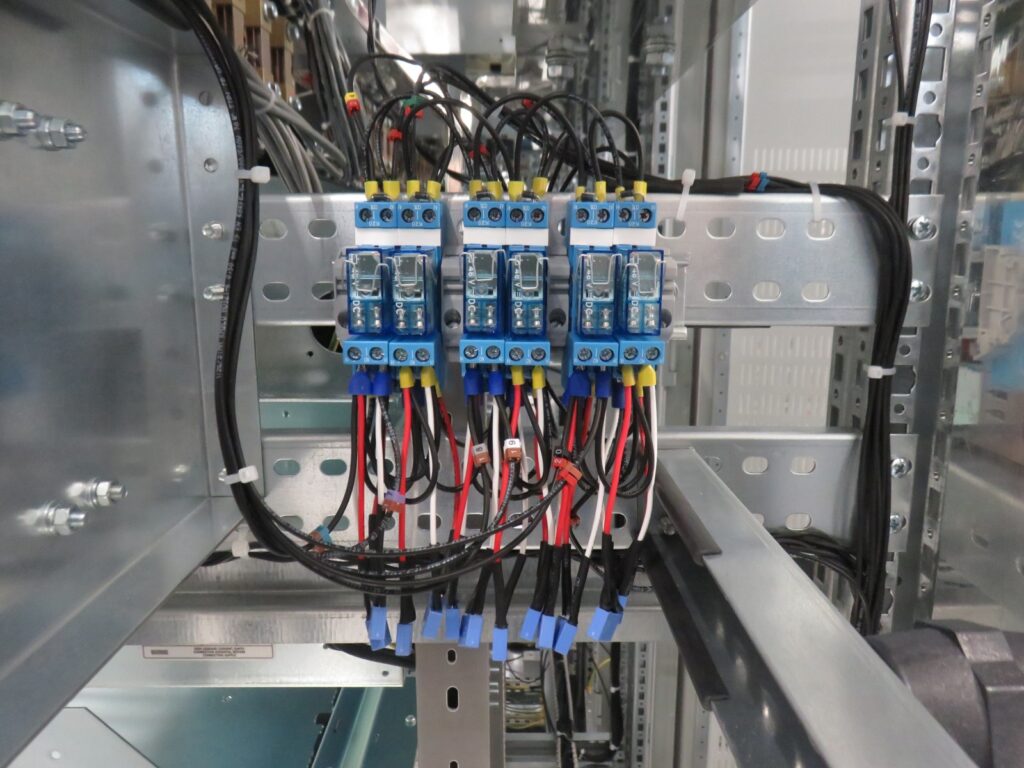
Or selectivity. Every converter in the chain — UPS, inverter, frequency converter — limits fault current by its nature. Downstream breakers chosen for the raw grid may never see enough current through a converter to trip. Coordinating protection through power electronics is a specialist exercise, and it is precisely the kind of question EPC Enerji’s application engineers settle at proposal stage, because the company designs the fault behaviour of every machine in the chain.
There is also the unglamorous interface layer: alarm contacts, communication protocols, battery monitoring, remote signalling. One engineering counterpart means one integration philosophy and one commissioning conversation — a detail that plant managers learn to price highly after their first multi-vendor commissioning season.
Sector Portraits: The Same Discipline, Different Accents
The systems approach expresses itself differently across the industries EPC serves, and the differences are instructive.
Power generation and transmission installations are built around the station DC system — rectifier-battery plants with certified autonomy, dual-branch redundancy, and earth-fault supervision — flanked by inverters for essential AC and UPS capacity for control rooms. Grid codes write the requirements; witnessed factory acceptance tests verify them; the equipment then serves silently for decades. EPC supplies this sector with systems documented and tested to that standard.
Oil, gas, and process plants add environment and consequence: elevated ambients, corrosive atmospheres, and the rule that safety systems fail last. Power architectures here layer redundancy — N+1 rectifiers, parallel UPS, dual buses — and demand equipment thermally and mechanically built with margin. The proposal that wins is the one whose loss calculations, derating tables, and heat loads are stated honestly.
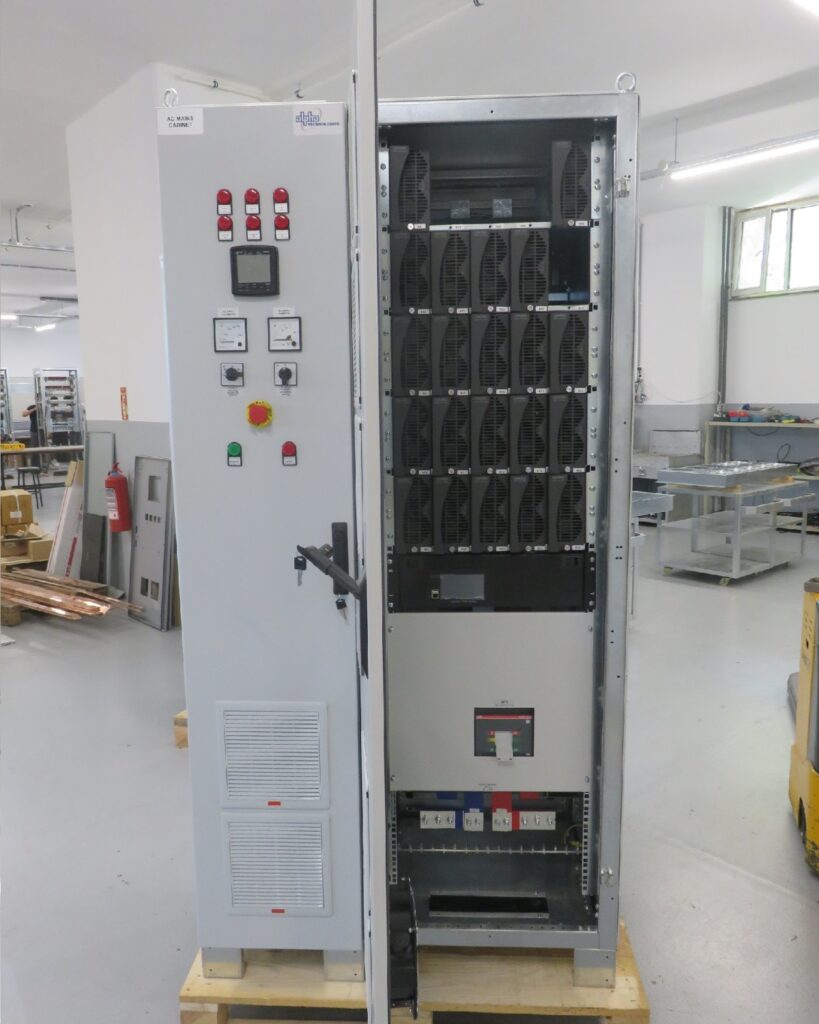
Middle East Telecom Project – 15kVA 12-Pulse Industrial UPS System
Marine and shipbuilding compresses an entire power architecture into a hull: shore connection converters bridging port frequency to ship frequency, chargers and inverters on the battery systems, UPS capacity for navigation and safety electronics — all classification-approved, vibration-tolerant, and salt-resistant. EPC’s marine references reflect years of exactly this work.
Defense programmes bring 400 Hz conversion, hardened construction, and quality assurance regimes that inspect everything twice. Serving this sector shapes a manufacturer’s habits permanently, and those habits carry into every commercial product built on the same lines.
Transportation networks — rail, metro, airports — distribute critical power across kilometres: signalling supplies, tunnel safety systems, station services, all battery-backed, all remotely monitored, all specified for decades of service.
Data centres and telecommunications turn continuity into arithmetic: availability targets, redundancy topologies, battery autonomies, and efficiency at partial load, where redundant systems actually live.
Industrial Frequency Conversion: Connecting 50 Hz, 60 Hz and 400 Hz Systems Efficiently
One company serving all of these learns something valuable: the sectors cross-pollinate. Marine vibration standards toughen industrial cabinets; defense documentation discipline sharpens utility submittals; telecom efficiency thinking trims every proposal’s operating cost. This accumulated breadth is a large part of what a customer actually buys when they bring EPC Enerji a power problem.
Custom Manufacturing: The Solution Half of “Solutions”
Standard products solve standard problems, and industrial reality declines to stay standard. The projects that define this field arrive with sentences like: the input is 690 V, the output must be 3×440 V 60 Hz, the ambient is 50°C, the footprint is fixed by a ship’s compartment, the classification society wants type approval, and delivery is inside the docking window.
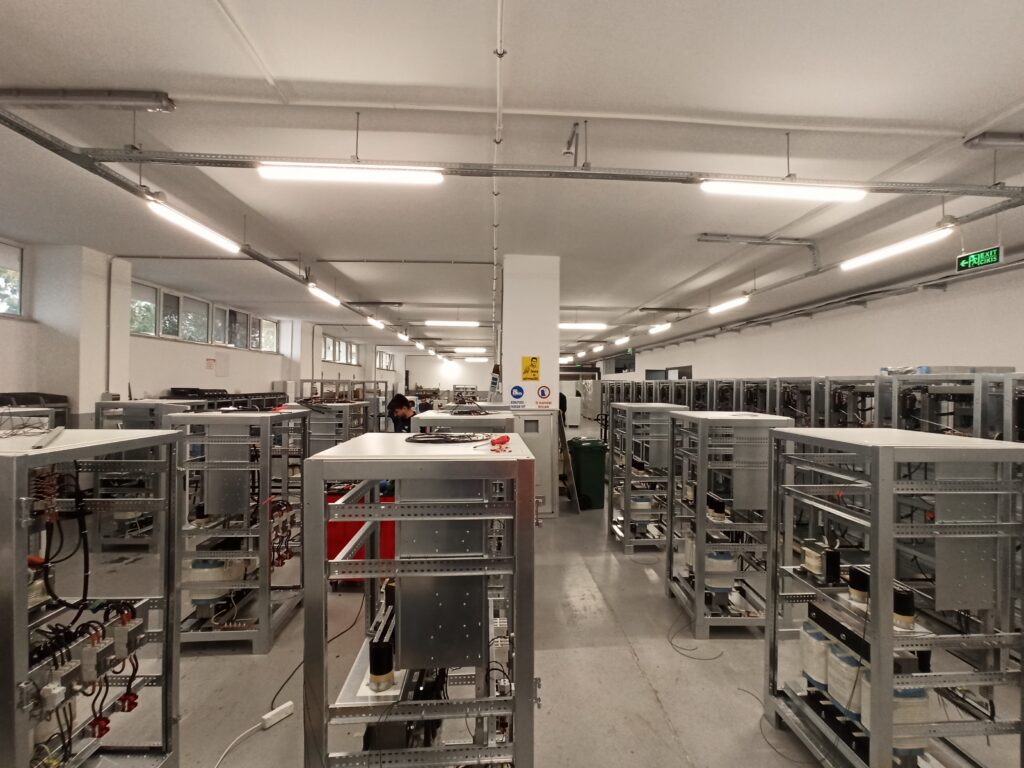
This is where in-house manufacturing stops being a corporate detail and becomes the product. EPC Enerji designs and builds to project specification at its Ümraniye facility — non-standard voltages and frequencies, unusual mechanical formats, extended environmental ratings, customer-specified protection philosophies, and documentation shaped to the approving authority. Factory acceptance tests run with the customer’s inspectors present. The engineers who answer the tender questions are the engineers who release the drawings. Across the dozens of countries in EPC’s export list, this ability to meet specifications as written — rather than negotiating them toward a catalogue — is the recurring reason the company gets the difficult projects.
Lifecycle: The Decade-Two Test
Industrial power equipment is bought once and lived with for twenty years, which makes the supplier’s longevity part of the specification. The practical questions are mundane and decisive. Are fans, capacitors, and battery replacements planned as maintenance or improvised as emergencies? Are spare modules a stock item in year twelve? Does anyone still employ an engineer who understands the unit? Can the system be modernised — a legacy charger replaced within its existing cabinet and cabling — rather than ripped out wholesale?
EPC structures for these questions deliberately: its own production base in Istanbul, a dealer and service network across its markets, retrofit engineering as a standing service line, and documentation practices inherited from its defense and utility work. The cheapest tender rarely survives comparison once the twenty-year column is filled in honestly.
A Facility Transformed: One Architecture Project, Start to Finish
The systems argument is best made by walking through it. Consider a composite drawn from real engagements: a mid-sized process plant, twenty years old, with the classic accumulated architecture — an aging UPS of extinct manufacture on the control system, a rectifier-battery set added with a substation upgrade, chronic summer voltage sags that everyone had learned to blame on the utility, a newer imported line running on a temporary transformer arrangement that had quietly become permanent, and a standby generator that had failed to hold the plant twice during real outages for reasons nobody had fully diagnosed.
What Are Industrial Rectifier Systems? Applications, Benefits & Types
The engagement began, as these should, with measurement and inventory: a week of power quality recording at the incoming supply and the critical buses, a load audit that separated the genuinely critical from the habitually protected, a battery discharge test that revealed the DC autonomy was half its nameplate, and a review of the generator failures that found the culprit — the old UPS rectifier’s inrush and harmonic behaviour, never coordinated with the generator’s alternator.
The architecture that came out of the study addressed the plant as one system. A three phase voltage regulator at the main board absorbed the chronic sags for the entire facility. The critical load inventory, now honest, shrank the UPS requirement by a third; the replacement was an industrial double-conversion system with an input characteristic explicitly coordinated with the existing generator, closing the failure mode permanently. The DC system was modernised within its existing cabinet and cabling — new charger, new battery, same footprint, changeover executed in a maintenance window with a temporary charger holding the bus. The imported line received a properly engineered converter, retiring the temporary transformer and its undocumented earthing. Alarm and monitoring interfaces were unified onto the plant SCADA with one signal philosophy.
No single element of this is remarkable. The result was: the plant’s power architecture went from an accumulation to a design, the generator has held every outage since, and — the detail the plant manager quotes — commissioning involved one engineering counterpart and one weekend. That is what industrial power supply solutions means when the phrase is earned, and it is the working method EPC Enerji brings to engagements of exactly this shape.
The Proposal Test: How to Recognise Systems Engineering Before You Buy It
Since every vendor now uses the word “solutions,” buyers need a way to distinguish the practice from the vocabulary, and the proposal document itself is the most reliable evidence. A genuine systems proposal contains things a product quotation structurally cannot: a single-line diagram of the offered architecture showing interfaces to the existing installation; a generator coordination statement where a generator exists; a protection and selectivity discussion acknowledging converter-limited fault currents; loss and heat schedules per room at the design ambient; battery sizing shown against certified discharge data rather than asserted; an alarm and signal list mapped to the site’s monitoring; a factory test programme the customer is invited to witness; and a delimitation of scope honest enough to name what the customer or third parties must still provide.
A quotation that is a price against a model number, however competitive, is a component sale wearing the solutions costume — legitimate for replacing a known machine, inadequate for building an architecture. EPC Enerji’s proposals are built to the first pattern as standard practice, because the company’s defense, marine, and utility customers have never accepted the second, and habits formed under demanding customers become the house style for all of them.
Custom Power Electronics Manufacturer: What to Look For Before You Commit
The Export Dimension: Architectures That Travel
A growing share of this systems work crosses borders. Contractors executing hospitals, industrial plants, ports, and infrastructure across the Middle East, Africa, the Caucasus, Central Asia, and further afield face a compounded version of the architecture problem: stressed local grids, mixed-origin equipment with mixed frequencies and voltages, destination authorities with their own conformity requirements, and sites where a missing cable lug costs a week. For these projects the value of a single engineering counterpart multiplies — one factory in Istanbul designing, building, and pre-testing the regulator, the UPS, the DC systems, and the converters as a matched set, with export documentation assembled for the destination and factory acceptance testing completed before anything is containerised.
EPC Enerji’s exported-countries list has been assembled one such project at a time, and the logistics discipline that comes with it — complete pre-shipment testing, spare part kits shipped with the systems, commissioning support planned rather than improvised — feeds back into the company’s domestic deliveries as well. Power architectures that must survive an ocean crossing and a customs process tend to be engineered with a thoroughness that benefits every customer.
Frequently Asked Questions
Where should a facility start — audit or equipment? Audit. A week of measurement at the incoming supply and the critical buses, plus an honest single-line review, usually reorders the shopping list entirely. EPC’s engineers routinely begin engagements exactly there.
Can existing equipment be integrated rather than replaced? Usually yes. Sound architectures are built around what works and replace what does not, interface by interface.
Does EPC deliver complete turnkey systems? Yes — from single machines to engineered multi-product systems with transfer schemes, monitoring, documentation, factory testing, and commissioning support, for domestic and export projects alike.
What about energy efficiency across all this equipment? It is designed in, machine by machine: partial-load efficiency in UPS and rectifier selection, regulators that process only the correction fraction, loss and heat budgets stated in the proposal so the operating cost is visible before purchase.
A closing note on timing: the cheapest moment to think architecturally is always the next purchase, whatever it is. A UPS replacement, a new line’s converter, a battery renewal — each is an opportunity to correct one interface, retire one assumption, and move the accumulated diagram a step toward a designed one, without ever declaring a grand masterplan project. Facilities that adopt this habit find their architecture converging on coherence within a normal equipment renewal cycle, funded entirely by purchases they would have made anyway. The only prerequisite is a counterpart who holds the whole picture across those purchases — which is, in one sentence, the working relationship EPC Enerji builds with its industrial customers.
The Standing Offer
A plant’s power supply architecture is either designed once, coherently, or redesigned continuously, expensively, by events. The first path begins with a conversation that covers the whole single-line diagram — sources, conversions, loads, failure modes, and the twenty-year plan — with a counterpart able to engineer and manufacture every box on it.
EPC Enerji — Energy Power Conversion — offers exactly that conversation. Rectifiers, inverters, industrial UPS, frequency converters, voltage regulators, transfer systems, and solar solutions, engineered and built in Istanbul, delivered into energy, marine, defense, transportation, telecom, and process industry projects across Türkiye and its export markets. Bring the single-line diagram to epcas.com.tr, and let the architecture be designed on purpose.