

Three Phase Frequency Converter for Industrial Machinery: Sizing and Purchasing Guide

A US-built machine tool arrives at a factory in Europe, Turkey or the Middle East. Its nameplate says 480 V, 60 Hz. The plant supply is 400 V, 50 Hz. Someone suggests a transformer to fix the voltage, and for a while it seems to work. Then the spindle runs about 17% slow, the hydraulic pump overheats, the cooling fans can’t keep up, and the motor starters behave strangely.
The voltage was only half the problem. The other half was frequency, and a transformer can’t change that. This is where a three-phase frequency converter comes in. This guide explains when you need one, how it works, how to size it properly, and what to check before buying.
When you need a three-phase frequency converter
The most common cases:
- Imported machinery built for 60 Hz (North America, parts of South America, Saudi Arabia, South Korea, parts of Japan, Taiwan, the Philippines) installed where the grid is 50 Hz, or the reverse.
- Factory testing for export. Manufacturers in 50 Hz countries that build equipment for 60 Hz markets need a 60 Hz supply to test it before shipping.
- Ships and offshore units that run at 60 Hz, docked at 50 Hz shore power, or vice versa.
- Laboratories and test benches that need a stable, adjustable frequency.
- Special frequencies for specific equipment, including 400 Hz, which we cover in a separate article.
Why not just run the 60 Hz machine on 50 Hz? Induction motors run at a speed proportional to frequency, so they slow down by about 17%. Pumps and fans lose flow and pressure. If the voltage isn’t reduced in proportion, the motor’s magnetic flux rises, it draws more magnetising current and overheats. Transformers, solenoids and contactors designed for 60 Hz can saturate at 50 Hz. Timing and speed-dependent processes go wrong. Some machines will run, some won’t, and most will wear out faster.
How a static frequency converter works

A static (solid-state) frequency converter is a double-conversion system:
- Input filter and transformer condition the incoming supply, reduce harmonics and provide isolation.
- Rectifier converts the 50 Hz three-phase AC into DC.
- DC link stores energy in capacitors and separates the input frequency from the output.
- Inverter builds a new three-phase AC output at the required frequency using IGBT switching.
- Sine filter and output transformer smooth the PWM output into a clean sine wave, set the output voltage (for example 480 V) and provide a neutral if needed.
The result is a fixed-frequency, fixed-voltage, sinusoidal three-phase supply that looks to the machine just like a 60 Hz grid.
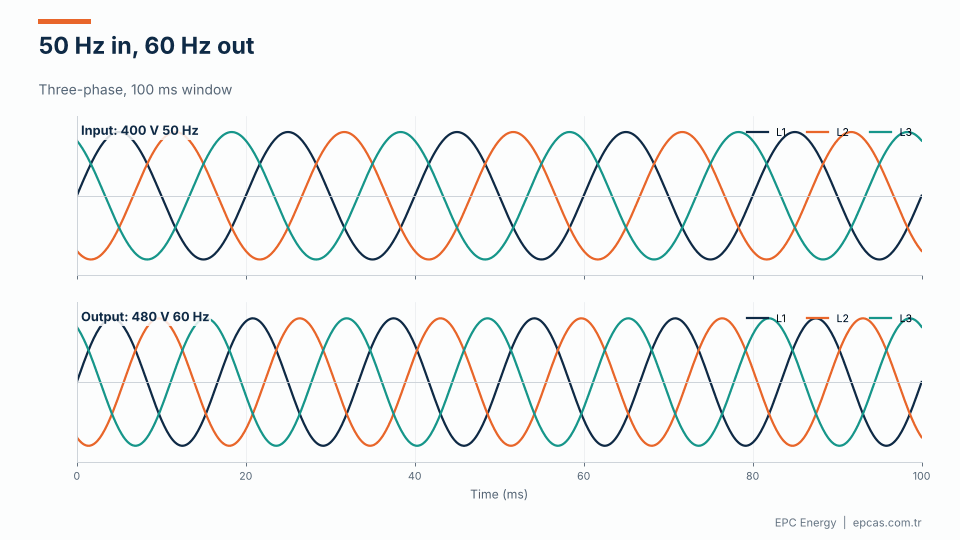
The animation shows the input at 400 V 50 Hz and the output at 480 V 60 Hz over a 100 ms window. In that time the input completes five cycles and the output six.
Frequency converter, VFD or rotary set?

These three are often confused.
Static frequency converter. Produces a fixed-frequency, fixed-voltage, sinusoidal bus that can supply a whole machine or panel, including motors, transformers, control circuits, heaters and electronics. This is the right tool for running a 60 Hz machine on a 50 Hz grid.
Variable frequency drive (VFD). Produces a variable-frequency, variable-voltage PWM output for a single motor, controlling its speed. It’s not designed to supply a general bus. Its output isn’t a clean sine wave, and many loads (transformers, contactors, electronics) won’t tolerate it. A VFD can make one 60 Hz motor run at 60 Hz speed from a 50 Hz grid, but it can’t power a whole machine with its controls, solenoids and auxiliaries.
Rotary motor-generator set. A motor running from the grid drives a generator producing the required frequency. Very clean output and naturally robust, but lower efficiency (often 80–88%), noisy, heavy and needing regular mechanical maintenance. Mostly found in older installations.
For most industrial machinery conversions today, the static frequency converter is the right choice.
Sizing: start with the running load
Sizing a frequency converter is mainly about two numbers: the continuous running load, and the worst-case starting event.
For the running load, list everything the machine draws from the supply:
- Main motors (spindle, conveyors, pumps, compressors), with rated kW, efficiency and power factor.
- Auxiliary motors (coolant, hydraulics, chip conveyor, fans).
- Heaters and resistive loads.
- Control and electronic loads (PLC, CNC, drives, HMI).
- Lighting and miscellaneous.
Convert each to kVA. A 45 kW motor at 93% efficiency and 0.88 power factor draws about 55 kVA. If the machine’s nameplate gives a total kVA or full-load current, use it, but check whether it represents real running load or a maximum.
Then check motor starting

This is where many converters are undersized. A direct-on-line (DOL) induction motor start draws six to eight times rated current for a second or more. A star-delta start draws two to three times. A soft starter, two and a half to four times. A motor on its own VFD, close to its rated current.
A static frequency converter’s overload capability is limited by its semiconductors. Typical values are 125–150% for 60 seconds and 150–200% for 10 seconds, though some designs offer more. If the largest motor on the machine starts direct-on-line and its starting current exceeds the converter’s overload capacity, the converter goes into current limit, the output voltage collapses, and either the motor fails to start or other loads drop out.
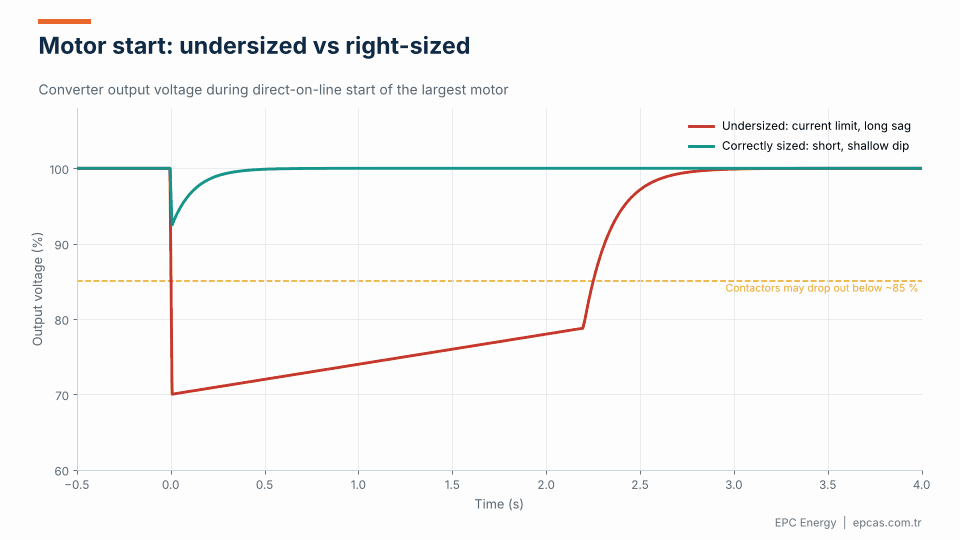
The animation compares an undersized and a correctly sized converter during a DOL start. The undersized converter hits current limit, and its output voltage sags to around 70% for over two seconds, enough to drop out contactors and trip electronics. The correctly sized converter shows a short, shallow dip and recovers almost immediately.
A worked sizing example
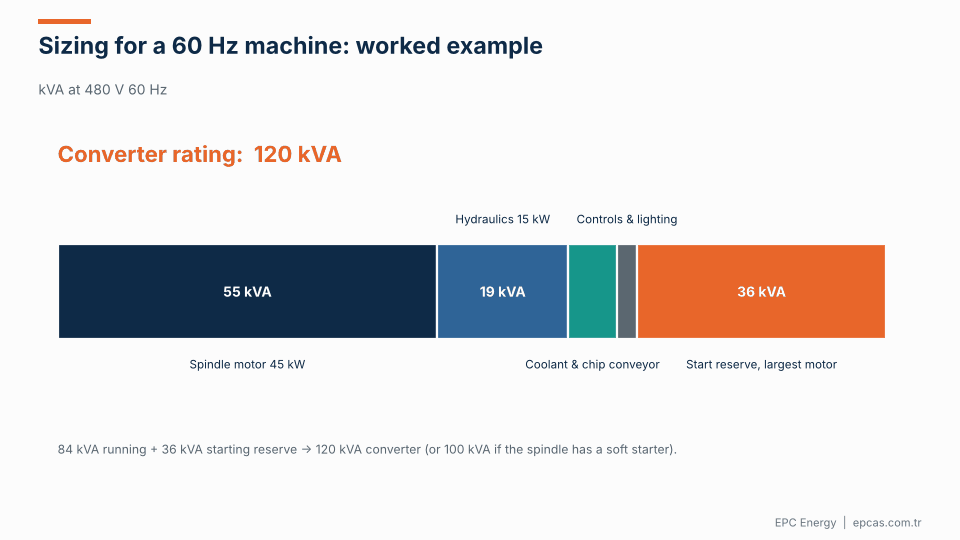
The animation walks through a 60 Hz machine tool:
- Spindle motor 45 kW: about 55 kVA
- Hydraulics 15 kW: about 19 kVA
- Coolant pump and chip conveyor: about 7 kVA
- Controls and lighting: about 3 kVA
- Running load: about 84 kVA
The spindle motor starts DOL. Its starting kVA at roughly 6 times rated current is about 330 kVA for a second or two, far beyond any converter’s overload capacity at 84 kVA. Options:
- Size the converter for the start, which can mean very large ratings. Usually uneconomic.
- Add a starting reserve so that, together with the converter’s overload capacity, the start voltage dip stays acceptable. In this example, about 36 kVA of reserve gives a 120 kVA converter.
- Change the starting method of the largest motor. A soft starter or a VFD on the spindle cuts starting current dramatically. With a soft starter, a 100 kVA converter may be enough.
Option 3 often gives the best overall result, but requires modifying the machine. It’s worth discussing with the machine supplier.
Other sizing considerations
Power factor and kW rating. Check that the converter’s kW rating, not just kVA, covers the load. Machines with many motors and old controls can have low power factor, which increases kVA.
Non-linear loads. Machines with their own drives, CNC power supplies or rectifiers draw harmonic currents. The converter must be designed to supply them without excessive voltage distortion. Ask for the converter’s THDv specification with non-linear load.
Unbalanced loads. If the machine has significant single-phase loads, the converter needs a four-wire output with neutral and the ability to maintain balanced voltages under unbalance.
Regenerative loads. Machines that brake motors, lower loads or decelerate large masses can push energy back into the supply. Most converters can’t absorb much regenerative energy. If the machine regenerates, the converter needs a braking resistor or regenerative capability.
Future expansion. If more 60 Hz machines may be added, a larger converter supplying a 60 Hz distribution bus may be cheaper than several smaller ones.
Input side considerations
The converter’s input draws power from the plant grid. Check:
- Input harmonics. A 6-pulse rectifier draws significant harmonic current. For large converters or plants with power quality limits, specify a 12-pulse or active front end.
- Supply capacity. The converter’s input current, including losses (efficiency is typically 92–95%), must be within the feeder’s rating.
- Generator supply. If the converter may run from a generator, the generator must be sized for its input characteristics.
Efficiency and running cost
A static frequency converter typically operates at 92–95% efficiency at rated load, lower at light load. For a converter supplying a machine that runs two shifts a day, the losses add up. A 120 kVA converter supplying 80 kW of real load at 94% efficiency loses about 5 kW, which over 4,000 operating hours per year is around 20 MWh.
That’s not a reason to avoid a converter, since there’s usually no alternative for a 60 Hz machine. But it is a reason not to oversize grossly, to compare efficiency figures at your actual operating point when evaluating offers, and to switch the converter off when the machine isn’t in use, if the process allows it.
Installation and environment
Frequency converters are usually installed in the plant’s electrical room or close to the machine. Consider:
- Ambient temperature and cooling. Converters generate heat; at 95% efficiency, a 120 kVA converter at full load dissipates several kilowatts.
- IP rating for dusty or humid factory floors.
- Static converters are much quieter than rotary sets, but cooling fans still make noise.
- Distance to the machine. Keep the output cable reasonably short, and size it for the output voltage and current.
Common mistakes
Choosing by the machine’s breaker size. The machine’s main breaker rating says little about its actual running load or starting current. Use the load list.
Forgetting the neutral. Many 60 Hz machines from North America use 277 V or 120 V single-phase circuits derived from a 480 V four-wire supply. If the converter only provides three wires, those circuits won’t work.
Using a VFD as a frequency converter. It may run the main motor, but contactors, transformers and electronics in the machine will be exposed to a PWM waveform they weren’t designed for.
Ignoring regeneration. Machines with heavy flywheels, lifts or fast deceleration can push energy back into the converter and trip it on DC link overvoltage.
No allowance for growth. The next imported machine arrives a year later, and a second converter costs more than a larger first one would have.
Commissioning tips
Before connecting the machine, check the converter’s output voltage, frequency and phase rotation at no load. Confirm the neutral and earthing arrangement match the machine’s requirements. Then start the machine’s auxiliaries first and the largest motor last, measuring the output voltage at the machine terminals during the largest motor start. If the dip is deeper than expected, review the starting method before production starts, not after the first nuisance trip.
Purchasing checklist

Before buying a three-phase frequency converter, answer these:
- Machine nameplate data: voltage, frequency, full-load current or kVA.
- Largest motor: kW and starting method.
- Load mix: motors, heaters, drives, electronics, single-phase loads.
- Neutral needed? Three-wire or four-wire output.
- Continuous operation or test duty? A production line runs continuously; a test bench may run intermittently but with frequent load changes.
- Site: ambient temperature, IP rating, distance from converter to machine.
- Input grid: voltage, frequency, short-circuit level, generator backup.
- Future: will more machines be added?
Frequently asked questions
Can I run a 60 Hz machine on 50 Hz power?
Some machines will run, but motors run about 17% slower, may overheat if the voltage isn’t reduced, and magnetic components can saturate. For reliable operation, a three-phase frequency converter supplying 60 Hz is the correct solution.
What’s the difference between a frequency converter and a VFD?
A frequency converter produces a fixed-frequency, sinusoidal supply for a whole machine or panel. A VFD produces a variable-frequency PWM output to control the speed of one motor and isn’t suitable as a general power supply.
How do I size a three-phase frequency converter?
Add up the running kVA of all loads on the machine, then check the starting current of the largest motor against the converter’s overload capability. If the start exceeds it, add a starting reserve or change the starting method.
Why does my frequency converter trip when the motor starts?
Most likely the motor’s starting current exceeds the converter’s overload capacity, causing current limit and voltage collapse. Fit a soft starter or VFD on the motor, or use a larger converter.
Is a static frequency converter better than a rotary converter?
For most new installations, yes. Static converters are more efficient, quieter, lighter and need less maintenance. Rotary sets remain in some legacy and specialised applications.
Frequency converters from EPC Energy
EPC Energy designs and manufactures three-phase frequency converters for imported machinery, export testing, marine shore power and special applications, along with static voltage regulators for voltage-only problems. Every converter is sized for your actual load mix and starting conditions, not picked from a catalogue. Send your machine data to epcas@epcas.com.tr and our engineers will recommend a rating and configuration.