

What is Industrial UPS?
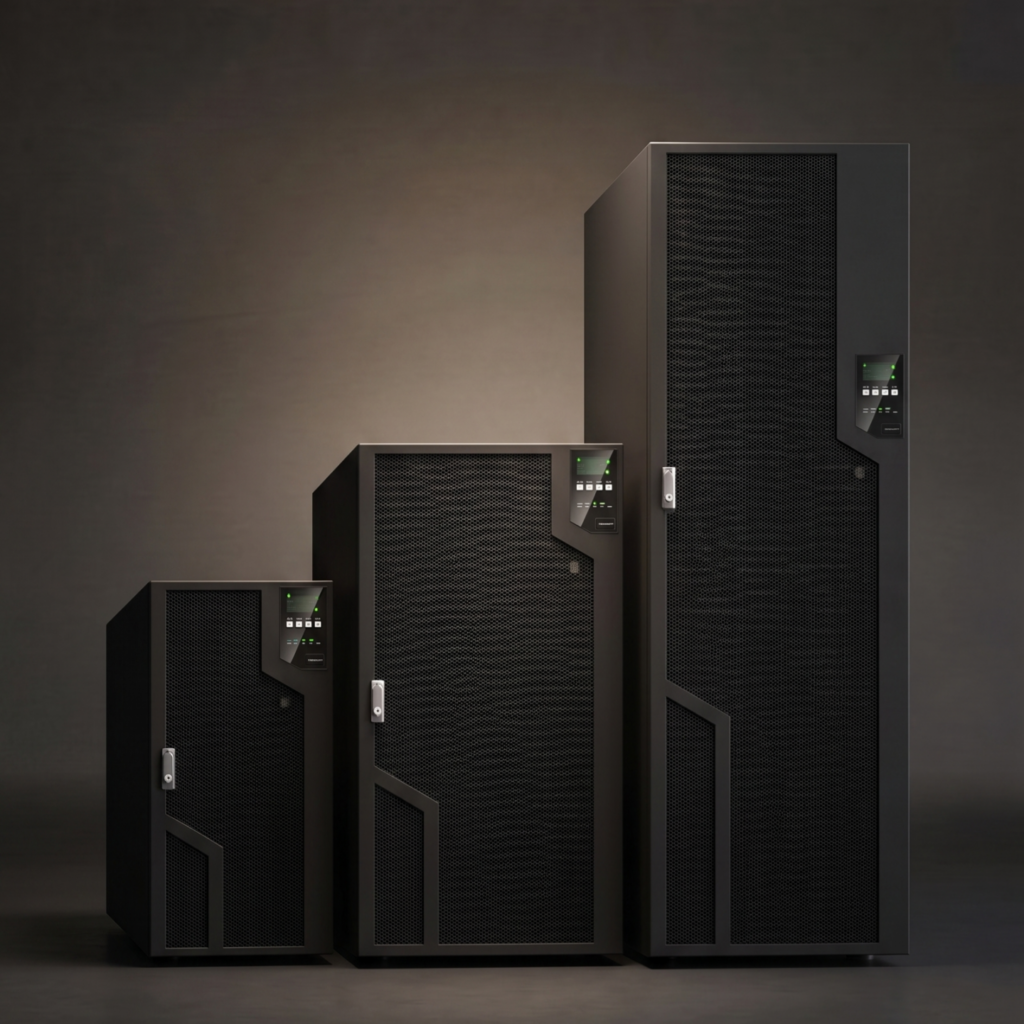
There is a specific moment, familiar to anyone who has commissioned a factory, when somebody suggests protecting the process control system with the same kind of UPS that sits under a desk in the accounting department — just a bigger one. It sounds economical. It is how DCS servers end up rebooting during a voltage dip, how a batch worth six figures gets scrapped, and how the phrase “industrial UPS” enters a company’s vocabulary the expensive way.
An uninterruptible power supply is not a category with one answer. The machine that suits an office — clean environment, forgiving IT loads, five-year horizon, a technician nearby — is structurally different from the machine that belongs in a cement plant, a substation relay room, an offshore module, or a metro tunnel. EPC Enerji manufactures true industrial UPS systems in Istanbul precisely because that second world plays by different rules, and the company’s customers in oil and gas, power generation, transportation, marine, and defense live in it every day.
The Anatomy of “Industrial” in an Industrial UPS
Strip away the marketing and the industrial qualification comes down to a handful of hard design choices.
Topology: Serious industrial protection means double-conversion (online) architecture: incoming AC is rectified to DC, the battery floats on that DC bus, and an inverter continuously regenerates clean AC for the load. The load never sees the raw mains at all. Sags, swells, frequency wobble, harmonics, and interruptions all die at the rectifier. Line-interactive and standby designs, common in commercial products, leave the load exposed and rely on fast switching — acceptable for a workstation, unacceptable for a turbine control panel.
Galvanic isolation: Industrial UPS systems from EPC include transformer isolation where the application requires it — separating the load from input disturbances and ground-fault paths, blocking DC injection, and allowing flexible earthing schemes that industrial plants and marine installations frequently demand. Transformerless designs saved cost and weight in the commercial world by discarding exactly this protection.
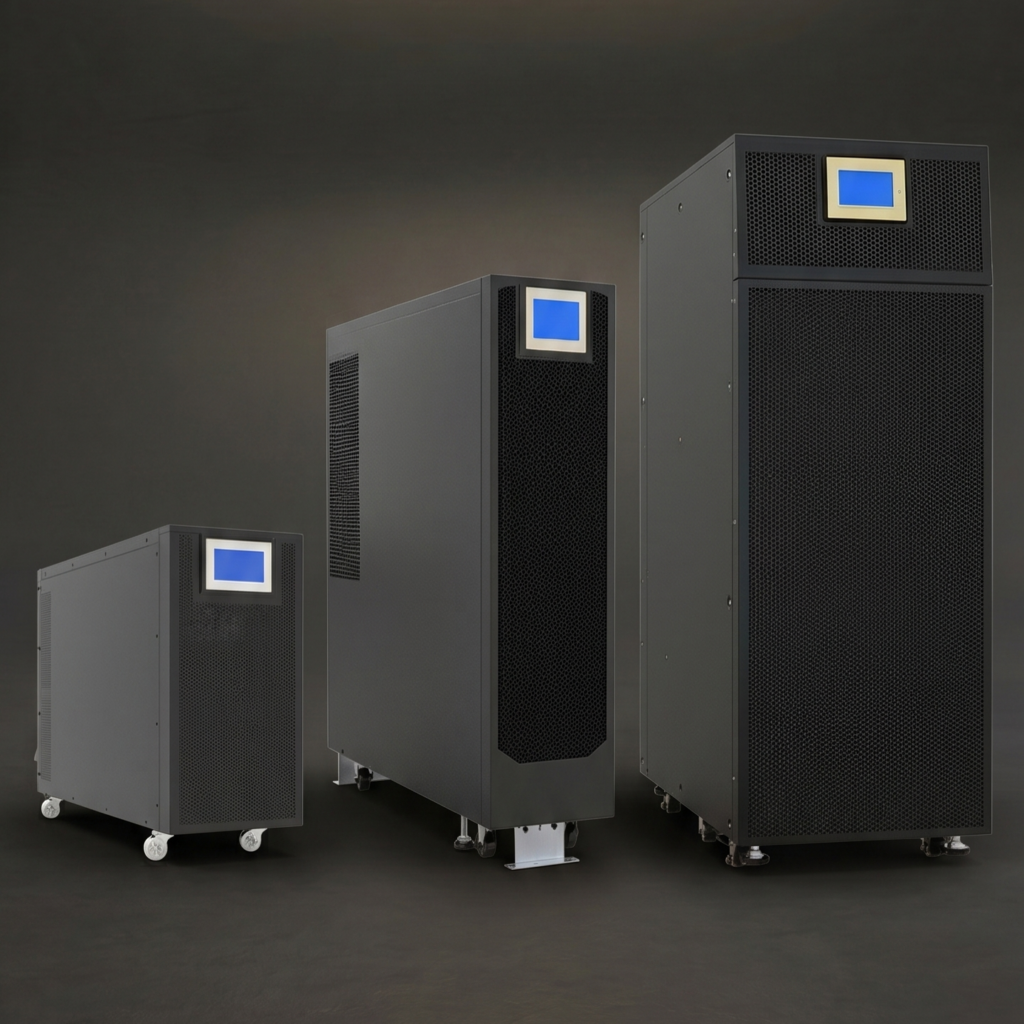
Overload and fault-clearing capability: An industrial UPS must start motors, energise transformers, and — critically — deliver enough short-circuit current, long enough, to trip a downstream breaker selectively. A UPS that responds to a branch-circuit fault by shutting down protects itself and sacrifices the plant. Industrial units are designed the other way around.
Environment: 40–55°C ambients, conductive dust, corrosive or salty atmospheres, vibration, and installation in electrical rooms rather than data halls. Conformal coating, generous cooling margins, robust enclosures with appropriate ingress protection, and components rated for the actual site are the baseline, not options.
Service life and serviceability: Commercial UPS product cycles run three to five years; industrial installations plan for fifteen to twenty. That difference cascades into everything: component selection, front-access maintenance, long-term spare part availability, and a manufacturer still answering the phone a decade after commissioning. EPC Enerji builds and supports its equipment on the industrial clock, backed by its own production facility in Ümraniye and a dealer and service network reaching across its export markets.
Loads That Justify an Industrial UPS — and What Losing Them Really Costs
The economics of industrial UPS protection are rarely about the electricity. They are about what a two-hundred-millisecond interruption does downstream.
- Process control systems. A DCS or PLC dropout in a refinery, chemical plant, or food line does not pause production; it triggers shutdown sequences, purges, restarts, and hours of recovery. The UPS protecting those controllers may be the highest-return asset in the building.
- Substation and power plant auxiliaries. Protection, control, and communication systems must survive precisely the grid disturbances they exist to manage. AC-side UPS systems complement the station battery here, and grid operators write hard availability requirements around both.
- Emergency and safety systems. Tunnel ventilation controls, fire and gas panels, emergency lighting circuits, evacuation systems. These loads are specified by regulation, tested by authorities, and unforgiving of shortcuts.
- Transportation infrastructure. Rail signalling, airport ground systems, metro station services — networks where a local power hiccup propagates into system-wide delay. EPC’s transportation references are built on exactly these applications.
- Marine and offshore. Navigation, communication, dynamic positioning support, and safety systems aboard vessels and platforms, where “call the utility” is not an available response to a power problem.
- Data and telecom infrastructure inside industrial sites. The server room in a factory lives in factory air and factory power quality; it needs a UPS built for that neighbourhood.
Against these consequences, the price difference between commercial and industrial equipment is usually noise. The trick is spending it on the right differences.
Redundancy: Deciding How Much Failure You Can Afford
Availability engineering for UPS systems is a menu, and each step up the menu buys a different class of protection.
A single unit with static and maintenance bypass covers the basics: the static bypass hands the load to reserve mains in milliseconds if the inverter fails or an overload exceeds capability, and the maintenance bypass lets technicians work on the UPS with the load still fed. This is the sensible minimum for any critical industrial load.
Parallel-redundant (N+1) systems run multiple UPS units sharing the load, sized so any one can fail without consequence. Dual-bus architectures feed genuinely independent A and B paths to dual-corded loads, removing common points entirely — the standard grammar of high-end data and control installations. Hot-standby arrangements suit retrofit cases and certain marine configurations.
There is no universally correct answer; there is a correct answer per installation, driven by the cost of downtime, the maintenance philosophy, and the honesty of the single-point-of-failure analysis. EPC Enerji engineers all of these architectures, and — usefully — manufactures the UPS, the rectifier, the inverter, and the static transfer switch sides of the equation, so the redundancy scheme arrives as one coherent system rather than a diplomatic negotiation between three vendors’ standard products.
What Are Industrial Rectifier Systems? Applications, Benefits & Types
Batteries: Where UPS Projects Quietly Succeed or Fail
Every UPS conversation eventually becomes a battery conversation, and industrial practice diverges sharply from commercial habit here.
Autonomy in industrial plants is sized to the process, not to a five-minute IT shutdown script: long enough to ride through generator start and stabilisation, or to bring a process to a safe state — often 30 to 60 minutes, sometimes hours for safety systems. Chemistry follows environment: VRLA where conditions are controlled, vented lead-acid or nickel-cadmium where temperatures, cycling, or expected service life push past VRLA’s comfort zone. Nickel-cadmium in particular remains the quiet standard in utility, rail, and oil and gas installations for a reason: it tolerates heat and abuse that would halve the life of anything else.
The UPS must be designed for the chosen chemistry — charging characteristics, temperature compensation, end-of-discharge management, boost regimes — which is another argument for a manufacturer that engineers per project. EPC delivers UPS systems matched to the battery the installation actually needs, with battery monitoring and the alarm interfaces the plant’s SCADA expects, rather than bending every project around one house chemistry.
Reading Past the Datasheet
A short field guide for anyone evaluating industrial UPS offers:
- Ask for overload capability as a curve — percent versus time — not a single number, and check it against the largest motor start on the bus.
- Ask for fault-clearing current and duration, then verify selectivity with the actual downstream breaker types.
- Ask for performance at nonlinear load and realistic crest factor, because that is what modern loads look like.
- Ask what the efficiency is at 25–50% load, where redundant systems actually operate, not at the flattering full-load point.
- Ask for type tests, sector references, and witnessed factory acceptance testing. A manufacturer comfortable with FAT in front of the customer’s inspector is telling you something; so is one who is not. EPC Enerji routinely tests systems with customers present at its Istanbul facility, and its reference list across defense, marine, energy, and transportation programmes has been built exactly that way.
Installation Realities That Deserve Early Attention
Three practical items save enormous trouble when addressed at the design stage. Ventilation: a UPS room’s cooling must handle full-load losses plus battery gassing requirements where vented cells are used. Cable and earthing philosophy: isolation transformers give freedom here, but the scheme should be decided on the drawing, not in the field. And generator coordination: the UPS rectifier’s input behaviour, walk-in characteristics, and harmonic footprint must be compatible with the standby generator’s sizing — a detail that has embarrassed many otherwise tidy projects. These are standing agenda items in EPC’s project engineering process, because the company delivers systems into real electrical rooms, not into ideal ones.
Oil & Gas Sector (Jordan) – 40kVA Multi-Cabinet Industrial UPS System Design and Manufacturing
A Worked Scenario: Protecting a Process Line Properly
To make the abstractions concrete, follow a representative project through its decisions. A chemical plant runs a continuous process whose DCS, field instrumentation, and emergency shutdown system must survive any supply event; the plant has a standby generator with a forty-second start-and-stabilise profile; the electrical room reaches 48°C in summer; the corporate standard requires N+1 on anything classed as safety-relevant.
The load study comes first and produces three tiers: the ESD system and DCS controllers (no interruption tolerable, 60 minutes autonomy to reach certified safe state), the operator stations and communications (no interruption tolerable, 30 minutes), and a set of essential motor loads that need only ride through to the generator. The first two tiers define the UPS scope — roughly 80 kVA of genuinely critical load once the inventory is disciplined, a fraction of the 300 kVA the first internal email proposed.
Architecture follows: two parallel-redundant industrial UPS units, each rated for the full load, double-conversion with output isolation transformers, fed from separate distribution boards, with a centralised static bypass and an external maintenance bypass. Battery: nickel-cadmium, chosen for the room temperature and the twenty-year plant horizon, sized from certified discharge tables at 48°C to the 60-minute duty. The UPS rectifiers are specified with walk-in and current-limit characteristics coordinated against the generator’s capability, and their harmonic footprint is checked against the generator’s alternator — the calculation that saves the commissioning week.
Custom Power Electronics Manufacturer: What to Look For Before You Commit
Every element of that story is a decision point where a commercial product would have defaulted and an industrial engineering process chose. It is also, in composite, an ordinary project at EPC Enerji: the load workshop, the architecture proposal, the battery arithmetic, the generator coordination, the witnessed FAT with the customer’s inspector initialling the overload and transfer tests, and the documentation file that the plant’s safety case will reference for two decades.
Standards and Sector Evidence: What “Certified” Should Mean
The phrase “certified UPS” is doing suspiciously little work in most brochures, so it pays to know what evidence actually matters per sector. General industrial installations look to the international UPS product standards covering safety, EMC, and performance classification — the latter defining how honestly output quality and transfer behaviour are declared. Marine installations add classification society type approval, with environmental and inclination testing that office equipment has never met. Defense programmes reference military environmental and EMC standards and audit the factory’s quality system as a condition of entry. Utilities and process operators layer their own technical specifications on top, then verify by witnessed test rather than by certificate alone.
Two buyer’s habits follow. First, ask for the test reports themselves, not the logo page — the difference between a type-tested unit and a “designed to meet” unit is the difference between evidence and aspiration. Second, weigh the manufacturer’s audit history: a factory that regularly passes defense and marine quality audits, as EPC Enerji’s Istanbul facility does, runs its commercial production to the same habits, because production lines do not switch cultures between orders.
The Operating Decade: Habits That Preserve the Investment
An industrial UPS spends its life doing nothing visible, which is precisely why disciplined operation matters. The habits that separate twenty-year installations from ten-year disappointments are few and specific. Load the system consciously: keep an updated record of what hangs on the critical bus, because criticality creep — convenience loads migrating onto the UPS — silently consumes the autonomy margin the safety case assumes. Test the transfers: exercise static bypass and maintenance bypass on schedule, so the first operation of a transfer path is never during an emergency. Prove the battery: periodic discharge testing against the design curve, because float voltage is not evidence of capacity. Replace on calendar, not on failure: fans and DC-link capacitors have known lives; scheduled replacement during a maintenance window costs a fraction of an unscheduled transfer to bypass. And keep the alarm chain alive: a UPS that has been signalling a fault to an unwatched panel for a month is a story every service organisation can tell.
The manufacturer’s half of the bargain is responsiveness and continuity — spare modules on the shelf, engineers who know the unit, and honest advice about when refurbishment beats replacement. EPC structures its service operation around installed-base longevity, which is what a customer is actually buying when the tender says “twenty years.”
Frequently Asked Questions
Industrial UPS versus commercial UPS — is the difference really structural? Yes. Topology, isolation, overload design, environmental rating, service life, and fault behaviour all differ by design intent, not by trim level.
Can an industrial UPS feed motor loads? Properly sized, yes — that is part of its definition. Starting current, not nameplate power, drives the sizing.
What autonomy should be specified? Enough to reach a defined safe state: generator online, process secured, or safety function completed. Minutes for some plants, hours for others — it is a process decision first and a battery calculation second.
Does EPC build custom configurations? Constantly. Non-standard voltages and frequencies, marine and defense requirements, seismic and environmental specials, unusual footprints, and specific certification packages are the company’s normal workload, engineered and manufactured in-house in Istanbul.
One more operational note earns its place here: keep the UPS in the plant’s management-of-change process. Electrical rooms evolve — new drives arrive, distribution boards are extended, generator settings are revised — and each change can silently alter the assumptions the UPS installation was engineered on. A two-line review question in the change procedure (“does this affect the critical power system?”) costs nothing and has saved more than one plant from discovering an incompatibility during an outage. Facilities that treat their UPS as living infrastructure, rather than as a box commissioned once, are the ones whose systems still match their documentation in year fifteen — and they are conspicuously overrepresented among EPC’s longest-running installations.
The Short Version
An industrial UPS is bought once and relied upon for two decades, mostly invisibly, occasionally decisively. The buying decision deserves the same seriousness as the switchgear it stands beside: real topology, real overload capability, a battery chosen for the site, an architecture matched to the cost of failure, and a manufacturer with the engineering depth to stand behind all of it.
EPC Energy — Energy Power Conversion — designs, manufactures, and services industrial UPS systems alongside its rectifier, inverter, and frequency converter range, supplying critical facilities across Türkiye and its export markets from its Istanbul manufacturing base. Send the load list, the environment, and the standards to the team at epcas.com.tr, and the reply will be a system engineered for your plant — not a catalogue page with your logo on the cover sheet.